
Lisa had been going in circles for three months. Her maternity leave was ending, she had two kids under five, and every childcare option she looked into either cost more than her mortgage or disappeared off the waitlist before she could get a callback. A friend mentioned an au pair. Another friend said nannies were the only reliable option. Her sister swore by her regular babysitter. By the time she called her husband to talk it through, she had four browser tabs open, two conflicting spreadsheets, and no clear answer.
If that sounds familiar, you're in good company. The childcare decision is one of the most stressful things a family faces, and the sheer number of options — each with its own costs, commitments, and trade-offs — makes it genuinely hard to compare fairly.
This guide cuts through the noise. It compares au pairs, babysitters, nannies, and daycare across the dimensions that actually matter: cost, flexibility, hours, legal obligations, what you get for your money, and what kind of family each option fits best. By the end, you'll know which direction makes sense for your situation — and why.

Schedules, tasks and costs with your au pair, in one app.

The Three Options, Briefly Defined
Before comparing, it helps to be clear about what each option actually is, because these terms get used loosely.
What Is an Au Pair?
An au pair is a young adult (typically 18–30) from another country who lives with your family and provides childcare in exchange for room, board, pocket money, and the chance to experience a new culture. The relationship is defined by cultural exchange as much as childcare — a principle upheld by the International Au Pair Association (IAPA), the global body that sets quality standards for au pair programmes. Au pairs work within a weekly limit that each country sets — 45 hours in the US, 30 in Germany, 25 in France and 16.5 in Austria, while the UK has no au pair scheme that sets hours (au pair rules by country) — attend language classes, and are treated as a temporary member of the family.
The live-in arrangement is central to the au pair model. Your au pair isn't a service provider who arrives at 8am and leaves at 6pm — they're in your home, sharing your meals, and woven into your daily family life.
What Is a Babysitter?
A babysitter is a person — often a teenager or student — who provides occasional, on-demand childcare, usually for evenings, weekends, or short daytime stretches. They don't typically have formal childcare qualifications, they're paid hourly, and they have no ongoing contractual commitment to your family. You call them when you need them.
Babysitters are the most casual and flexible option. They're also the most limited: you can't rely on a babysitter for 30 hours of weekly coverage, and you shouldn't.
What Is a Nanny?
A nanny is a professional childcare provider who works for your family on a regular basis — usually full-time or part-time, usually weekdays. Unlike an au pair, a nanny is an employee: they're paid a salary, you handle payroll taxes, and they almost always live in their own home (though live-in nannies exist). Nannies typically have childcare training or significant experience and are paid at professional rates.
A nanny is essentially a hired specialist. The relationship is more formal and the cost reflects that.
What Is Daycare?
Daycare (or nursery / Kita in Germany) is a licensed facility where children are cared for in a group setting, typically by multiple trained staff. Daycare centres follow strict safety regulations, offer structured curricula, and provide a social environment where children interact with peers daily. Most centres operate on fixed schedules — roughly 7:30am to 5:30pm on weekdays — and close for public holidays.
Daycare is often the most affordable option for a single child, but the cost doubles with each additional child, and the fixed hours are a dealbreaker for families with unpredictable schedules. The waitlist situation in many cities — especially in Germany, where Kita spots can take months to secure — adds another complication.
The Big Comparison: Au Pair vs. Babysitter vs. Nanny vs. Daycare
Key takeaway: No single option is universally "best." Each serves a different family profile, budget, and childcare need. The right question isn't "which is best?" — it's "which fits my family?"
| Au Pair | Babysitter | Nanny | Daycare | |
|---|---|---|---|---|
| Lives with family? | Yes | No | Usually no | No (facility) |
| Hours | Country limit: 45/week in the US, 30 in Germany, 25 in France, 16.5 in Austria (rules) | On-demand, occasional | As agreed in the contract | The centre's opening hours |
| Cost (monthly, Germany) | €280 pocket money plus room, board, insurance and at least €840 a stay for the German course (BA sheet) | €0 (when not booked) | Your nanny's rate × hours | Your Kita's fee, per child |
| Cost (monthly, USA) | Stipend at the rate your sponsor applies (22 CFR § 62.31 names no dollar amount) | $0 (when not booked) | Your nanny's rate × hours | $13,184 a year national average, 2025 (Child Care Aware of America) — your centre's tuition, per child |
| Contract / commitment | 6–24 months | None | Ongoing employment | Term-based enrollment |
| Cultural exchange | Yes — core feature | No | No | Limited |
| Language exposure for kids | Yes | Rarely | Sometimes | Sometimes (bilingual programs) |
| Peer socialisation | Limited | No | No | Yes — core benefit |
| Flexibility (ad hoc) | Moderate | High | Low | Very low |
| Flexibility (regular schedule) | High | Low | High | Low (set hours) |
| Formal qualifications | Not required | Not required | Often yes | Staff are licensed |
| Childcare for multiple kids | Same cost | Per hour, per booking | Same salary | Cost per child |
| Employer responsibilities | Minimal | None | Full employment | None (they employ staff) |
| Sick child accepted? | Yes (they're home) | Depends | Usually yes | No — must stay home |
| Holiday cover | Flexible | Available | Needs vacation | Closed on holidays |
Comparing Costs by Country
Childcare costs vary significantly depending on where you live. This table only prints a figure where an official source or a published price survey states it; everywhere else it tells you what to ask for. Nanny and daycare prices depend on your city, the hours and the children's ages, so a national range would tell you little about your own quote.
| Country | Au Pair (monthly) | Nanny | Daycare (per child) |
|---|---|---|---|
| Germany | €280 pocket money, plus at least €840 a stay towards the German course (BA sheet) | Your nanny's hourly rate × hours; at least the minimum wage of €13.90 an hour since 1 January 2026 (Minijob-Zentrale) | Your Kita's fee, set by your Land and municipality |
| USA | Stipend at the rate your sponsor applies, plus up to $500 a year for course work (US rules) | Your nanny's hourly rate × hours; the median wage of childcare workers, the occupation that includes nannies, was $16.82 an hour in May 2025 (Bureau of Labor Statistics) | $13,184 a year national average price of child care in 2025 (Child Care Aware of America) |
| UK | No au pair scheme: National Minimum Wage applies (UK rules) | Your nanny's hourly rate × hours | Your nursery's fee |
| France | At least €320 pocket money (Service-Public) | Your nanny's hourly rate × hours | Your crèche's fee |
A few important notes on these numbers:
- Au pair costs include pocket money plus the host family's obligations (insurance, room and board, language course contribution). For Germany specifically, see our complete au pair cost breakdown.
- Nanny costs in the USA include the employer's share of Social Security and Medicare taxes — 7.65% of cash wages (6.2% plus 1.45%) once you pay $3,000 or more in 2026 (IRS Publication 926 (2026)). The US Department of State J-1 Visa Exchange Visitor Program regulates au pair placements in the USA. The regulation, 22 CFR § 62.31, sets the stipend as a weekly rate based on 45 hours under the Fair Labor Standards Act and names no dollar amount, so no US au pair figure appears in this table — enter your sponsor's rate in the stipend calculator.
- Babysitters are excluded from this table because they're not a substitute for full weekly coverage — you'd pay per booking at the sitter's own hourly rate, so ask the sitters you are considering.
The cost difference is significant at every level. For families with two or more children, the gap grows even wider: a nanny's salary doesn't change based on how many kids you have, and neither does an au pair's pocket money. A babysitter, however, charges by the hour regardless of how many children are in the room.
A note on daycare costs: Daycare is often the cheapest option for a single child, particularly in countries with subsidised systems (Germany's Kita fees are set by each Land and municipality and are often income-based; France's crèche system is heavily subsidised). But daycare costs multiply per child. At the US national average of $13,184 a year for one child in 2025 (Child Care Aware of America), two children come to $26,368 a year — and a nanny's pay stays the same for two.
The Effective Hourly Rate: What You're Actually Paying
Raw monthly costs can be misleading because each option delivers different hours, different coverage types, and different levels of convenience. The effective hourly rate — total monthly cost divided by usable childcare hours — tells a more honest story.
Work it out with your own prices — this guide prints no market rates for nannies, sitters or daycare, because your local quote is the only one that counts:
| Option | Monthly cost (your figures) | Usable hours/month | What changes the result |
|---|---|---|---|
| Au pair | Pocket money or stipend + course contribution + room, board and insurance | Up to your country's weekly limit × 52 ÷ 12 — in Germany 30 hours a week (BA sheet) | The same for one child or three |
| Babysitter | The sitter's hourly rate × hours booked | Only the hours you book | Short bookings, evenings |
| Nanny | Hourly rate × contracted hours, plus the employer's taxes and contributions | The contracted hours | Full-time spreads the fixed costs over more hours |
| Daycare | The centre's fee × number of children | The centre's opening hours, minus closures and sick days | Every extra child adds a fee |
A few things usually jump out:
- Daycare is often cheapest per hour but inflexible — you get zero value from those hours if your child is sick, the centre is closed for holidays, or you need coverage outside the 8am–5pm window.
- Au pairs are often the cheapest per hour for in-home care, especially with several children — and unlike daycare, those hours are flexible. Need coverage at 6:45am? Done. Need someone to handle the afternoon school pickup and homework? Built in.
- Full-time nannies are cheaper per hour than part-time nannies because you're spreading the fixed cost over more hours. But the total monthly cost is a full salary, not pocket money.
- Babysitters are often the most expensive per hour and only make financial sense for occasional, short bookings.
Key takeaway: When you factor in flexibility, in-home convenience, and the flat cost for multiple children, au pairs deliver the best value per usable hour for families whose weekly need fits inside their country's au pair limit.
What About Daycare?
Daycare deserves its own section because it's the option most families evaluate alongside — or before — considering in-home care.
Daycare strengths
Socialisation is the biggest advantage daycare has over every in-home option. Children learn to interact with peers, share, take turns, and navigate group dynamics from an early age. Most centres follow a structured curriculum with age-appropriate activities, early literacy, and physical play. Centres are licensed and regulated, with government-mandated safety standards, staff background checks, and child-to-adult ratios. And from the parents' perspective, there's no employer paperwork — the centre handles all employment, insurance, and HR.
In countries with subsidised systems, daycare can also be the most affordable option for a single child. In Germany, Kita fees are set by each Land and municipality and often depend on income — ask your local Jugendamt or Kita for the fee that applies to you.
Daycare limitations
The most common frustrations families report with daycare are the rigid schedule (centres open on set hours, usually weekdays only), sick-child exclusion policies (fever, rash, or stomach bug means your child stays home — and so does a parent), holiday closures (many German Kitas close for several weeks a year — ask for the closure calendar), and illness exposure (children in group settings tend to catch more infections in their first year of attendance).
For families with multiple children, cost is also a real constraint. Daycare charges per child — at the US national average of $13,184 a year in 2025 (Child Care Aware of America), two children cost $26,368 a year, and a full-time nanny's pay does not rise with the second child.
And in high-demand cities — Berlin, Munich, London, Paris, San Francisco — securing a daycare spot can mean a long waitlist.
When daycare works best
Daycare is the right primary choice for families with one child, two parents on predictable 9-to-5 schedules, and a reliable backup plan for sick days and holidays. It's also the best choice for families who prioritise early socialisation and structured learning environments.
When daycare isn't enough on its own
Most families who rely on daycare eventually discover gaps: the 7am start, the 6pm pickup, the sick days, the three weeks of closure. This is where complementary options come in. The most common pairing in Europe is daycare plus an au pair — the child gets morning socialisation at the centre and afternoon personal attention at home. We cover this and other combinations in the hybrid models section below.
When a Babysitter Is the Right Choice
Babysitters are underrated when used correctly and overextended when used as a substitute for structured childcare.
A babysitter is the right choice if:
- You need occasional coverage — one or two evenings a week, weekend mornings, or date nights
- You have backup childcare for your regular schedule and need gap cover
- Your children are older (school-age kids with a predictable routine don't need a live-in caregiver)
- You're not ready for a long-term commitment and need flexibility month to month
A babysitter is not the right choice if:
- You need consistent weekday morning and afternoon coverage
- You have an infant or toddler who needs continuity of care
- You're regularly working more than 15–20 hours per week
The on-demand nature of babysitting is its strength and its limit. For occasional needs, it's perfect. For families who need reliable, repeating coverage, it falls short — you're one cancellation away from scrambling.
When a Nanny Is the Right Choice
A nanny is the premium option, and for some families, it's worth every cent.
A nanny makes sense if:
- You need full-time, professional coverage — 40+ hours per week, year-round
- You have one young child who benefits from consistent one-on-one professional care
- You don't have a spare bedroom or aren't comfortable with someone living in your home
- You value formal qualifications and experience in your childcare provider
- You want clear employer-employee boundaries with defined hours and contract terms
A nanny may not be the right fit if:
- Cost is a significant constraint (especially for families with two or more children)
- You want your children to have cross-cultural experiences and language exposure
- Your schedule is irregular and you need morning, evening, or weekend flexibility
- You're looking for a longer-term, family-integrated arrangement
The nanny model is essentially hiring a professional specialist. The relationship is more transactional by design — that's not a criticism, it's a feature for families who want clear professional boundaries. But it comes at a cost that puts it out of reach for many households.
When an Au Pair Is the Right Choice
The au pair model is the most distinctive of the three, and it's the one most families misunderstand before they try it.
An au pair is a strong fit if:
- You have two or more children — the cost-per-child equation shifts dramatically in the au pair's favour
- You need flexible, irregular coverage — early mornings, late afternoons, occasional evenings
- You travel for work and need someone in the home who can adapt to shifting schedules
- You want cultural enrichment for your children — language exposure, different perspectives, broader horizons
- You're comfortable with a live-in arrangement and have the space for it
- You want a genuine relationship, not just a service contract
That flexibility comes with a practical catch: it only works when everyone can see the same plan. Families who keep the week in one calendar the whole household reads — which is what AuPairSync is built for — spend a lot less time renegotiating who is doing the Thursday pickup.
An au pair is probably not the right fit if:
- You don't have a private room to offer
- Your household runs better with strict professional boundaries
- You need more childcare hours than your country's au pair limit (30 a week in Germany, 25 in France, 45 in the US — rules by country)
- You can only commit to a few months (most au pair arrangements are 6–24 months)
Key takeaway: The au pair model is fundamentally different from hiring childcare. You're not purchasing a service — you're welcoming someone into your family. Families who thrive with au pairs are those who embrace that distinction rather than fight it.
The Flexibility Question
Flexibility means different things in each model, and it's worth unpacking carefully.
Au Pair Flexibility
An au pair provides structural flexibility — because they live with you, coverage before school, after school, early mornings, and occasional evenings is built into the arrangement. You don't need to book ahead for your 7am start or arrange a pickup because you're stuck in a meeting.
What an au pair can't provide is unlimited hours on demand. Each country caps au pair hours — 45 a week in the US, 30 in Germany and the Netherlands, 25 in France, 16.5 in Austria (rules by country) — and those hours should follow a predictable weekly schedule. Spontaneous late evenings every week would violate the spirit (and often the letter) of the arrangement.
For managing that weekly schedule clearly — so both you and your au pair know exactly what's expected — tools like AuPairSync's calendar feature help families plan the week ahead and avoid last-minute confusion.
Nanny Flexibility
A nanny offers professional reliability within agreed hours. If your nanny is contracted for Monday through Friday, 7:30am to 5:30pm, that's your window. Anything outside it is overtime, which either needs to be agreed and paid additionally, or it doesn't happen.
For families with irregular schedules or unpredictable work demands, that rigidity can create friction.
Babysitter Flexibility
Babysitters are maximally flexible — you use them when you want and don't when you don't. The trade-off is reliability. Popular babysitters are in demand; your preferred sitter may not be available when you actually need them.
The Cultural Exchange Dimension
This section doesn't appear in most childcare comparison guides, but it should.
When you host an au pair, your children grow up with a person from another country at their breakfast table. They hear another language spoken naturally, not as a lesson. They learn that a family in Colombia or Korea or France has the same rhythms of homework, bedtime, and Saturday mornings — and different ones, too.
These aren't abstract benefits. Children who grow up in culturally diverse environments show measurable gains in empathy, linguistic flexibility, and cognitive adaptability. A year with an au pair from another country can be the start of a child's interest in languages, travel, and the wider world. Platforms like AuPairWorld connect families with au pairs from over 180 countries, making this kind of cultural exchange more accessible than ever.
Neither a nanny nor a babysitter typically provides this. They may be wonderful caregivers, but the cultural exchange element is specific to the au pair model.
If you have school-age children, particularly in the 5–12 age range, the exposure effect is especially strong. Hearing French, Spanish, or Japanese at home during those years plants seeds that last a lifetime.
Live-In vs. Live-Out: What It Really Means
One of the biggest practical differences between an au pair and a nanny (or babysitter) is the living arrangement — and it affects everything from your household dynamics to your grocery bill.
Living with an Au Pair
Having a live-in au pair means:
- Coverage before and after your work day without logistical coordination
- A dedicated private room required (not optional)
- Your household expanding — meal planning, bathroom schedules, house rules
- A person to include in family life — holidays, outings, family dinners
The live-in arrangement demands genuine thought about house rules and expectations. Not because au pairs are difficult — but because living with another adult requires clarity about shared spaces, quiet hours, phone use, guests, and dozens of other things families navigate intuitively among themselves but need to articulate explicitly for someone new.
Hiring a Live-Out Nanny
A live-out nanny keeps your household space to yourself. They arrive, they work, they leave. For families who value privacy and clear professional separation, this is genuinely appealing. The trade-off is that coverage is bounded by their arrival and departure times, with no buffer.
For the onboarding week, whether you're welcoming an au pair or a new nanny, the investment in clear communication upfront pays dividends for months.
What Families With Multiple Children Should Know
If you have more than one child, the financial calculus of childcare changes significantly — and almost always in favour of the au pair.
Consider a family in Germany with two children, ages 2 and 5, needing 30 hours of weekly coverage — the German au pair limit, or about 130 hours a month (30 × 52 ÷ 12):
- Babysitter: the sitter's hourly rate × 130 hours. For an employed sitter the statutory minimum wage alone — €13.90 an hour since 1 January 2026 (Minijob-Zentrale) — comes to €1,807 a month, and that's for 30 consistent hours, which no babysitter arrangement realistically provides
- Nanny: the nanny's hourly rate × 130 hours, with the same €13.90 floor, plus the employer's contributions
- Au pair: €280 pocket money and €70 a month towards the German course (BA sheet), plus room, board and insurance — regardless of how many children are in the household
The pocket money doesn't increase because you have twins. The insurance doesn't double. The room-and-board cost is the same. An au pair looking after two children costs the same as one looking after one — and the children often benefit from having consistent, familiar care together.
For larger families — three or more children — the case for an au pair becomes even stronger. No other model provides this kind of cost-efficiency at comparable hours of coverage.
Coordinating Childcare Across a Busy Household
Regardless of which option you choose, the day-to-day logistics of managing a caregiver can get complicated fast — especially when you're juggling school pickups, activity schedules, doctor appointments, and your own work calendar.
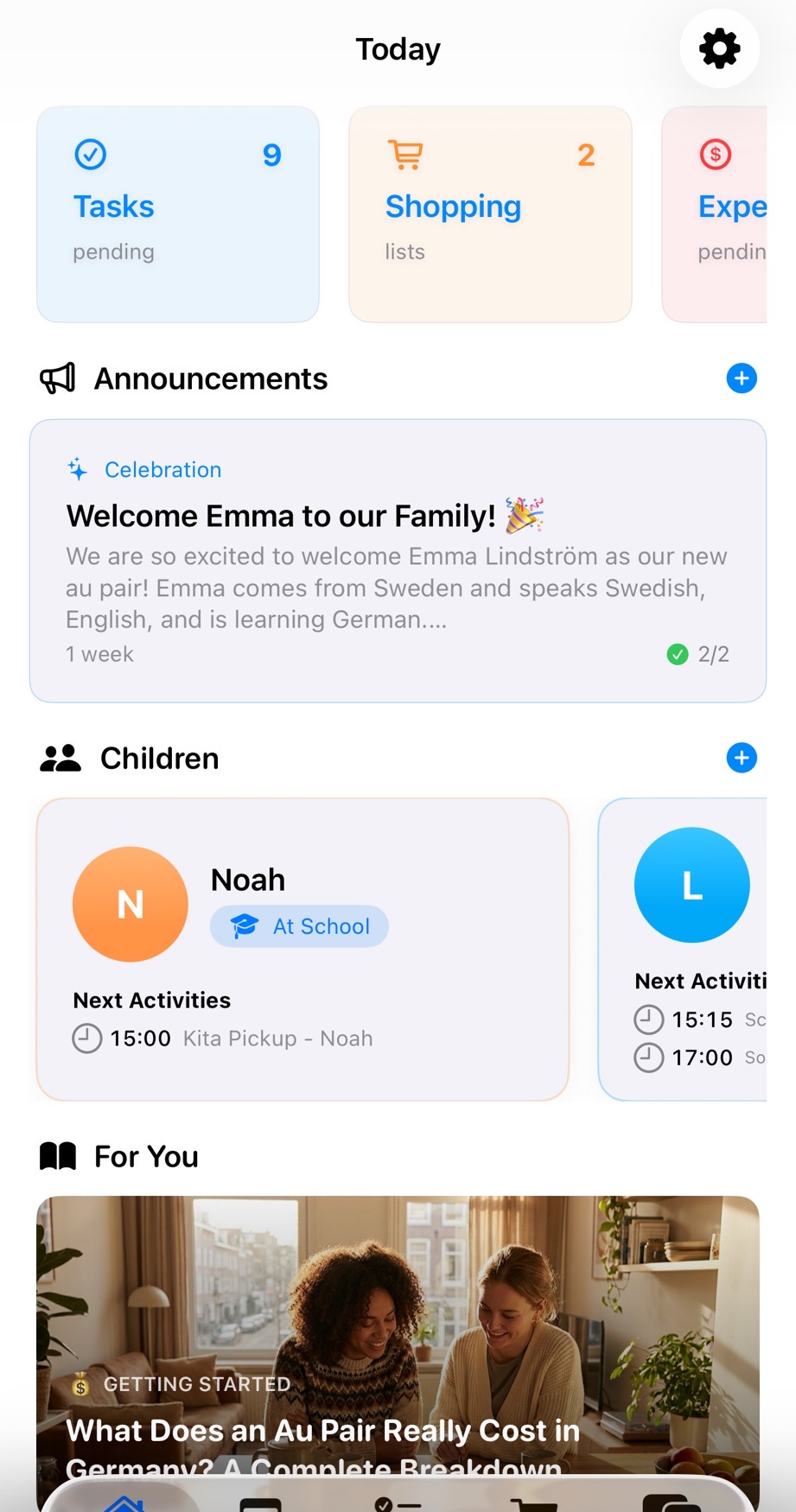
Families who've used AuPairSync's shared dashboard note that having one central place for schedules, shopping lists, and task assignments eliminates the daily back-and-forth that eats up time and causes miscommunication. It works equally well for au pair arrangements and for coordinating with a nanny or regular babysitter — the coordination challenge is the same regardless of the model you choose.
The Decision Matrix: Score Your Family's Fit
Comparison tables tell you facts. A decision matrix tells you which facts matter most to your family. Rate each dimension from 1–5 based on how important it is to you, then see which option scores highest.
| Dimension | Weight it 1–5 | Au Pair | Babysitter | Nanny | Daycare |
|---|---|---|---|---|---|
| Monthly cost | ___ | ⭐⭐⭐⭐⭐ | ⭐⭐⭐ | ⭐⭐ | ⭐⭐⭐⭐ |
| Cost per child (2+ kids) | ___ | ⭐⭐⭐⭐⭐ | ⭐⭐ | ⭐⭐⭐⭐ | ⭐⭐ |
| Schedule flexibility | ___ | ⭐⭐⭐⭐ | ⭐⭐⭐⭐⭐ | ⭐⭐ | ⭐ |
| Reliable weekly coverage | ___ | ⭐⭐⭐⭐ | ⭐⭐ | ⭐⭐⭐⭐⭐ | ⭐⭐⭐⭐⭐ |
| Early morning / evening cover | ___ | ⭐⭐⭐⭐⭐ | ⭐⭐⭐ | ⭐⭐ | ⭐ |
| Professional qualifications | ___ | ⭐⭐ | ⭐⭐ | ⭐⭐⭐⭐⭐ | ⭐⭐⭐⭐⭐ |
| Peer socialisation | ___ | ⭐⭐ | ⭐ | ⭐ | ⭐⭐⭐⭐⭐ |
| Cultural exchange / language | ___ | ⭐⭐⭐⭐⭐ | ⭐ | ⭐ | ⭐⭐ |
| Sick child accepted | ___ | ⭐⭐⭐⭐⭐ | ⭐⭐⭐ | ⭐⭐⭐⭐ | ⭐ |
| No live-in required | ___ | ⭐ | ⭐⭐⭐⭐⭐ | ⭐⭐⭐⭐⭐ | ⭐⭐⭐⭐⭐ |
| No employer obligations | ___ | ⭐⭐⭐⭐ | ⭐⭐⭐⭐⭐ | ⭐ | ⭐⭐⭐⭐⭐ |
| Long-term continuity (2+ years) | ___ | ⭐⭐ | ⭐⭐ | ⭐⭐⭐⭐⭐ | ⭐⭐⭐⭐⭐ |
How to read the matrix
- Fill in your weight (1 = doesn't matter, 5 = critical) for each row
- Multiply weight × stars for each option
- Add up the totals — the highest score is your best-fit option
Key takeaway: Most families who run this exercise find that one option pulls ahead clearly. If two options tie, the deciding factor is almost always whether or not you're comfortable with a live-in arrangement.
Three family profiles, scored
To show how different priorities lead to different answers:
Profile A: Dual-income parents, two kids (ages 3 and 6), need 25 hrs/week They weighted cost per child (5), early morning cover (5), and cultural exchange (4) highest. Result: Au pair wins by a wide margin. Daycare scores well on cost but loses on flexibility and the fact that costs double for two children.
Profile B: Single parent, one toddler (18 months), works from home, needs 35 hrs/week They weighted professional qualifications (5), reliable weekly coverage (5), and peer socialisation (4) highest. Result: Daycare + babysitter combo wins. Full-time daycare covers the structured hours, and a babysitter fills the occasional evening gap. A nanny is the runner-up but significantly more expensive.
Profile C: Part-time working parent, school-age child, needs 8 hrs/week They weighted schedule flexibility (5), no live-in (5), and low cost (4) highest. Result: Babysitter is the obvious choice.
Profile D: Family with three kids (ages 2, 5, 8), both parents in office full-time They weighted cost per child (5), reliable weekly coverage (5), and sick child accepted (5) highest. Result: Au pair wins decisively. With three children, daycare costs triple, and daycare won't accept sick kids — meaning a parent stays home every time one child has a cold.
Hybrid Models: Combining Options
Not every family fits neatly into one category, and the best solution is sometimes a combination.
Au Pair + Babysitter
The au pair handles the regular weekday schedule (school drop-off, afternoon shift, homework). A local babysitter covers the occasional Saturday evening or the nights when both parents have work events. This gives you the consistency of a live-in arrangement with the flexibility of on-demand backup.
Nanny + Babysitter
A part-time nanny covers your core weekday hours. A babysitter fills the gaps — evenings, weekends, or the odd school holiday when the nanny is off. This is common in families where the nanny's hours don't stretch to cover everything.
Daycare + Au Pair
In many European families, especially in Germany, the most popular combination is Kita in the mornings and an au pair from midday onward. The child gets the socialisation of a group setting plus the personal attention and language exposure of a live-in au pair. This works especially well for children between ages 1 and 5.
This combination also solves daycare's biggest weakness: the hard stop at 5pm. When both parents work past pickup time, the au pair bridges the gap — and covers sick days when daycare sends the child home.
Daycare + Babysitter
The budget-friendly combination. Daycare handles the weekday structure, and a regular babysitter fills in for evenings, holidays, and the occasional Saturday. This works well for single-child families on a moderate budget who don't want a live-in arrangement.
Au Pair + Nanny (sequential)
Some families start with a nanny during the infant years (when professional training and experience matter most) and switch to an au pair once the youngest child turns two or three. The cost savings are significant, and by that age, children benefit enormously from the cultural exchange dimension.
Key takeaway: "Which one?" is sometimes the wrong question. "Which combination?" can be the better one — especially if your needs are split between regular structured hours and occasional ad-hoc cover.
Real Family Scenarios
The Relocating Family
James and Petra moved from London to Munich with their two children (ages 4 and 7). Neither child spoke German. They hired an au pair from Austria — partly for childcare, partly as a cultural bridge. Within three months, both children were conversational in German. The au pair helped navigate the German school system, translated at parent-teacher meetings, and gave the family a trusted local guide during their most disorienting months. A nanny might have provided better professional childcare. But no nanny would have provided that specific combination of cultural integration and language immersion.
The Shift-Working Nurse
Maria works three 12-hour shifts per week in a hospital, rotating between days and nights. No single childcare model covers her needs. Her solution: a childminder (Tagesmutter) during regular daytime hours, and a trusted babysitter for the overnight and early-morning gaps. An au pair wouldn't work — her schedule is too irregular for a consistent 30-hour pattern, and she's often sleeping during the day when the au pair would need supervision.
The Freelancer Couple
David and Sophie both work from home as freelancers. Their hours are unpredictable — sometimes they're both free by 3pm, sometimes neither is available until 7pm. They chose an au pair specifically for the live-in flexibility. On light days, the au pair finishes early and enjoys free time. On heavy days, the au pair stays on through dinner and bedtime. The weekly total stays within 30 hours, but the distribution shifts week to week. They manage this with a shared calendar where both parents and the au pair can see the upcoming week's plan.
Making the Final Decision: A Practical Framework
If you're still unsure which direction to go, run through these questions:
Do you have a spare private bedroom?
- No → Au pair is ruled out. Consider a nanny or babysitter.
- Yes → Continue.
How many hours of weekly childcare do you need?
- Under 15 hours/week → Babysitter may be sufficient.
- From 15 hours/week up to your country's au pair limit (30 in Germany, 25 in France, 45 in the US — rules by country) → Au pair is a strong candidate; part-time nanny also possible.
- Above that limit → Full-time nanny is the more reliable choice; au pair can supplement but not carry the full load.
How many children do you have?
- One child, under 2 → Nanny's professional qualifications may justify the cost.
- Two or more children → Au pair almost always wins on cost-efficiency.
- School-age children only → Babysitter for evenings; au pair if you need regular before/after school coverage.
How important is cultural exchange?
- Very important → Au pair, specifically.
- Neutral → Any option.
Can you commit to a 6–12 month arrangement?
- Yes → Au pair is a genuine option.
- No → Stick with a nanny or babysitter until you can.
What's your monthly budget?
- Price the au pair (pocket money or stipend, course, room, board, insurance) and a nanny (local hourly rate × your hours, plus employer contributions) with your own figures.
- Below a full-time nanny's cost → Au pair is usually your best full-coverage option.
- Between the two → Part-time nanny or au pair.
- Enough for a full-time nanny → Full-time nanny is accessible.
Legal Obligations and Tax: What You Need to Know
One of the most overlooked differences between childcare options is the paperwork. The legal and tax obligations vary dramatically depending on which model you choose — and getting them wrong can be expensive.
Au Pair: Minimal employer obligations
In most countries, au pairs are not classified as employees. They're cultural exchange participants. This means:
- USA: Au pairs on J-1 visas are exempt from Social Security and Medicare taxes (FICA). Host families don't need to set up payroll. However, the stipend is subject to income tax, and the au pair files using Form 1040-NR. Host families may be eligible for the Child and Dependent Care Tax Credit for au pair stipend payments.
- Germany: Au pairs receive pocket money (currently €280+/month), and the host family arranges health insurance and a language course. There are no payroll taxes or social security contributions.
- UK: There is no au pair scheme. GOV.UK says au pairs are entitled to the National Minimum Wage (accommodation you provide is taken into account when calculating it) and may have to pay Income Tax and National Insurance depending on what they earn. The employer keeps records proving the minimum wage is paid. See the UK rules page.
The administrative burden is minimal, which is one of the reasons the au pair model is so accessible for families who don't want to become employers.
Nanny: Full employer responsibilities
Hiring a nanny means you become an employer, with everything that entails:
- USA: If you pay a nanny cash wages of $3,000 or more in 2026, you must withhold and pay Social Security and Medicare taxes (7.65% each for employer and employee — IRS Publication 926 (2026)), file Schedule H with your tax return, and potentially pay federal and state unemployment taxes (FUTA/SUTA). Many families use a payroll service like SurePayroll or HomePay. Failure to handle "nanny taxes" properly can result in penalties — this is the so-called "nanny tax" issue that has derailed political careers.
- Germany: Nannies must be employed on a proper contract (Arbeitsvertrag) or registered as a Minijob (up to €603 a month on average in 2026 — Minijob-Zentrale). Social insurance contributions apply above the Minijob threshold.
- UK: PAYE, National Insurance, pension auto-enrolment, holiday pay, and sick pay obligations all apply.
Babysitter: Usually no obligations
For occasional babysitting (a few hours per week, cash payment), most families have no legal employer obligations. In the USA, you only trigger household employment tax rules if you pay the same babysitter cash wages of $3,000 or more in 2026 (IRS Publication 926). In Germany, families often arrange a Minijob registration for regular babysitters.
Daycare: Zero employer paperwork
You're a customer, not an employer. The centre handles all staff employment, insurance, and compliance. You just pay the fee.
Key takeaway: If avoiding employer paperwork is important to you, au pairs and daycare are the simplest options. Nannies come with real administrative overhead — or the cost of outsourcing it to a payroll service.
What If It Doesn't Work Out?
No childcare guide is complete without addressing the uncomfortable question: what happens when the arrangement fails?
Au pair rematch
If the relationship between a host family and their au pair breaks down, most agency programmes offer a "rematch" process — the au pair is reassigned to another family, or the family is matched with a new au pair. The process typically takes 1–2 weeks. It's disruptive, but the system is designed for it. We've written a detailed au pair rematch guide for families navigating this situation.
Firing a nanny
Terminating a nanny is a formal employment action. Depending on your jurisdiction, you may owe notice periods, severance, accrued holiday pay, and a final payslip. In Germany, notice periods of 4–12 weeks are standard. In the UK, statutory notice applies. Getting this wrong can result in employment tribunal claims.
Leaving a babysitter
There's nothing to unwind. You simply stop calling them. This is the advantage of the casual model — zero exit cost.
Leaving daycare
Most centres require 1–3 months' written notice. Some charge cancellation fees. And if you leave, getting back in may mean rejoining the waitlist — which, in competitive markets, can mean months without a spot.
Frequently Asked Questions
Is an au pair cheaper than a nanny?
Usually, yes. In Germany an au pair receives €280 a month in pocket money, and the host family adds at least €840 a stay for the German course, insurance, and room and board (BA sheet); in France the pocket money is at least €320 a month (Service-Public). In the USA, the stipend is the weekly rate your sponsor applies — 22 CFR § 62.31 names no dollar amount — plus up to $500 a year for course work, the sponsor's fee and room and board. A full-time nanny is a salary: the hourly rate × the contracted hours, plus the employer's taxes and contributions — at least the €13.90 minimum wage an hour in Germany (Minijob-Zentrale); in the US the median wage of childcare workers, the occupation that includes nannies, was $16.82 an hour in May 2025 (Bureau of Labor Statistics). The difference grows for families with multiple children, since au pair costs don't increase per child.
Can an au pair replace a full-time nanny?
For families whose weekly need fits within the au pair limit, yes — an au pair can be a full replacement. For families needing more hours of professional care than that, an au pair alone won't be sufficient. Au pair working hours are capped by each country — 45 hours a week in the USA, 30 in Germany and the Netherlands, 25 in France, 16.5 in Austria (rules by country) — and the arrangement is built on cultural exchange, not employment.
What is the maximum number of hours an au pair can work?
In the USA, au pairs on J-1 visas can work up to 45 hours per week and no more than 10 hours per day. In Germany the limit is 30 hours a week and 6 a day, in the Netherlands 30 a week, in France 25 and in Austria 16.5; the UK has no au pair scheme that sets hours. Each figure and its official source is on our au pair rules by country page.
Do I have to pay taxes for an au pair?
In the USA, au pair stipends are exempt from Social Security and Medicare taxes (FICA) because J-1 visa holders are considered nonresident aliens. The au pair is responsible for filing their own income tax return. In Europe, host families typically have no tax obligations for au pair pocket money. See the IRS guidance on au pairs for US-specific details.
Is daycare better than an au pair for socialisation?
Daycare provides group socialisation that no in-home option can match — children learn to share, cooperate, and interact with peers daily. An au pair provides different social benefits: cultural exchange, language exposure, and a close mentoring relationship. Many families combine both: daycare for mornings and an au pair for afternoons.
Can I have an au pair and use daycare at the same time?
Absolutely — this is one of the most popular combinations in Europe. The child attends Kita or crèche in the morning for socialisation and structured learning, and the au pair handles the afternoon pickup, homework, activities, and evening routine. This gives the family flexibility while keeping the au pair's hours within the legal limit.
What happens if my au pair doesn't work out?
Most au pair agencies facilitate a "rematch" process. The au pair is reassigned to another family, and you're matched with a replacement. The process typically takes 1–2 weeks. While disruptive, it's a standard part of the au pair system and one reason agencies exist.
Which childcare option is best for families with multiple children?
An au pair is almost always the most cost-effective option for families with two or more children. The cost is flat regardless of how many children are in the household. By contrast, daycare charges per child, and babysitters charge by the hour regardless of headcount. Nannies don't charge extra per child, but their total cost is 3–4× higher than an au pair.
The Bottom Line
There is no universally right answer to the au pair vs. babysitter vs. nanny vs. daycare question. Each option serves a different family profile, and the honest answer for most families is: it depends.
What you can do is be honest about what you actually need — not what sounds nicest in the abstract, but what your family's daily reality requires. How many hours. How much flexibility. How much you can spend. How you feel about someone living in your home. Whether your children need group socialisation or personal attention. Whether you're ready to be an employer.
For families with two or more children, irregular schedules, and a genuine openness to cultural exchange, the au pair model is remarkably hard to beat. For families who need professional qualifications and clear boundaries, a nanny makes more sense. For families who need occasional cover and nothing more, a babysitter is perfectly adequate. And for families who prioritise socialisation and structured learning on a budget, daycare — potentially combined with an au pair or babysitter for the gaps — is a strong foundation.
The goal isn't to find the "best" childcare option — it's to find the right one for you.
Ready to explore the au pair path? Get AuPairSync to get your family organised from day one — schedules, house rules, shopping lists, and everything in between, all in one place.