
An au pair in Germany costs a host family at least €350 a month in fixed payments: €280 pocket money and €70 towards a German course (BA information sheet 1.6, 1.7). Over a twelve-month stay that comes to €4,200 (€3,360 pocket money plus €840 for the course). You also pay the au pair's health and accident insurance and the travel to the language course, and you provide a room and meals in your home.
Those amounts come from the Federal Employment Agency's au pair sheet, the reference Germany uses in place of an au pair law (Federal Employment Agency au pair sheet, April 2023). The sheet doesn't put a price on insurance, food or transport, because those depend on your insurer and your city. This guide shows you where each of those numbers comes from, so you can price them for your own family instead of trusting someone else's average.


Schedules, tasks and costs with your au pair, in one app.

Au pair costs in Germany at a glance
| Cost | Amount | Required? |
|---|---|---|
| Pocket money | €280 a month | Yes |
| German course | At least €840 over the stay (€70 a month or one payment of €840) | Yes |
| Travel to the German course | The fare; a Deutschlandticket costs €63 a month | Yes |
| Health and accident insurance | Depends on insurer and age: get quotes | Yes, the family pays all premiums |
| Room and board | An own room and the same meals as the family | Yes |
| Liability insurance | Ask your household insurer | Recommended by many agencies |
| Agency fee | Whatever you agree with the agency | Only if you use one |
| Flights | Usually paid by the au pair | No |
| Fixed minimum | €350 a month, €4,200 for twelve months | BA information sheet 1.6, 1.7 |
Everything in the "Yes" rows is set by the Federal Employment Agency's au pair sheet, apart from the Deutschlandticket price, which comes from the Federal Government.
Pocket money: €280 a month
The sheet sets the pocket money at €280 a month, independent of how many hours of housework the au pair does (Federal Employment Agency). It calls this pocket money rather than a wage, because the point of an au pair stay is learning the language and getting to know the country. Au pair placements are not subject to compulsory social insurance.
The sheet we cite is the April 2023 edition. We couldn't find a newer one, so check the linked PDF for a later version before you sign a contract.
You can pay more than €280 if you want to. No official source says what families typically pay on top, so we don't print a number for it. To work out what you owe in a given month, including the course contribution, use the au pair stipend calculator.
German course: at least €840 over the stay
Paying towards the course isn't optional. The host family has to contribute at least €840 in total to the au pair's German lessons. You can pay it as €70 a month for the whole stay or as a single payment of €840, and you only owe it as far as the course costs actually arise. On top of that you pay the travel to the nearest suitable German course (Federal Employment Agency au pair sheet, April 2023).
The course happens in the au pair's free time, and you have to let them go to it. If the course is reached by local transport, a Deutschlandticket at €63 a month since January 2026 (Federal Government) covers local and regional trains and buses across Germany, so it usually covers the trip to the course as well.
Insurance: the host family pays every premium
Au pairs aren't covered by German social insurance, so you have to insure them privately. The au pair must be insured against illness, pregnancy and childbirth, and accidents, and the sheet says all premiums are paid by the host family (Federal Employment Agency). Au pairs from outside the EU bring the insurance confirmation to their visa appointment, so sort it out before they apply.
What the policy costs depends on the insurer and the au pair's age, and no official source states a price. Ask two or three insurers for an au pair policy quote and put the real figure in your budget. Have the policy start on the au pair's first day in Germany.
Many au pair agencies also recommend liability insurance. If you already have a private liability policy, ask your insurer whether it can include the au pair as a member of your household.
Room and board
The host family provides board and lodging free of charge. In practice that means an own room in the family home, and the au pair eats with the family and gets the same food (Federal Employment Agency).
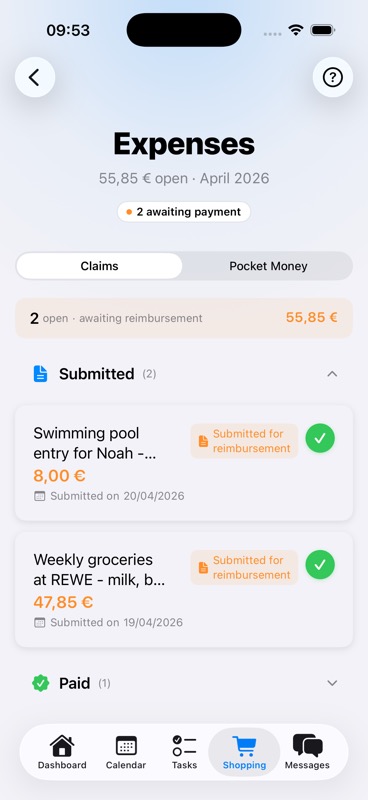
You probably have the room already. The groceries and utilities for one more adult are a real cost, but the amount depends so much on your household that a national figure would be a guess. The easiest way to get your own number is to track it for the first two months. Small shared costs drift easily: groceries your au pair picks up, a pharmacy run, pocket money handed over in cash. AuPairSync keeps shopping lists and reimbursements in one place, so the monthly guess becomes an actual figure.
If your au pair buys groceries or supplies for the children, agree up front on how reimbursement works, so it doesn't turn into an awkward conversation at the end of the month.
One-time costs
Agency fee. You can find an au pair yourself or use an agency. What an agency charges the host family is freely agreed, so ask each agency for its fee in writing and what it covers. The au pair's side is capped: a private agency may charge the au pair at most €150 including VAT, and only once the contract is legally in place (BA information sheet, section 3). For guidance on setting clear expectations from the start, see our post on house rules for au pairs.
Flights. The sheet says the au pair normally pays the journey to Germany and back. Some families contribute anyway, for example to the return flight at the end of the year. That's your choice, not a rule.
Getting the room ready. Bedding, a SIM card, maybe a bicycle for the school run. None of it is required. Our first-week survival guide lists what's worth preparing before your au pair arrives.
Holiday and time off
An au pair who stays a full year gets four weeks of paid holiday; for shorter stays it's two working days for each full month. Every week they also get at least 1.5 full days off and four free evenings, and at least one Sunday a month must be free (BA sheet). The holiday costs you nothing extra in pocket money, but you still need childcare during those weeks, whether that's a grandparent, a babysitter or your own leave. The au pair vacation calculator works out the days for your contract.
How an au pair compares with other childcare
| Childcare option | Monthly cost | Hours of coverage |
|---|---|---|
| Au pair | €280 pocket money and €70 course contribution (BA sheet) plus insurance, room and board | Up to 30 hours a week and 6 a day (BA sheet) |
| Nanny (part- or full-time) | Hourly rate × contracted hours, plus employer contributions; at least the €13.90 minimum wage an hour since 1 January 2026 (Minijob-Zentrale) | As contracted |
| Kita (daycare) | Your Kita's fee, set by each Land and municipality and often income-based | The Kita's opening hours |
| Babysitter (hourly) | The sitter's hourly rate | On demand |
Nanny, Kita and babysitter prices depend on your city and the hours you need, so the table tells you what to ask for instead of printing a national range. One difference holds everywhere: an au pair's pocket money is the same whether you have one child or three, while a nanny's hours and a Kita's fees grow with each child.
For more detail on how the working hours fit into a week, see how to structure your au pair schedule.
Budget checklist before you commit
- Pocket money of at least €280 a month agreed in the contract
- Course contribution planned: €70 a month or €840 once, plus travel to the course
- Health and accident insurance quoted, starting on the au pair's first day
- Liability cover checked with your own insurer
- Room ready, and a first estimate for extra food and utilities
- Agency fee confirmed in writing, or the independent route chosen
- Flight contribution decided (optional) and told to the au pair
- Replacement childcare planned for the au pair's holiday weeks
Hosting in the United States instead? The costs are built differently there: a weekly stipend, a sponsor's program fee and an education allowance. This video goes through a full US year.

Frequently asked questions
How much does an au pair cost per month in Germany?
At least €350 a month in fixed payments: €280 pocket money and €70 towards the German course. On top of that the host family pays the au pair's health and accident insurance, the travel to the language course, and provides a room and meals.
How much pocket money does an au pair get in Germany?
€280 a month, according to the Federal Employment Agency's au pair sheet (April 2023 edition). The amount does not depend on how many hours the au pair works.
Do host families have to pay for the au pair's German course?
Yes. The host family contributes at least €840 over the stay, either as €70 a month or as one payment of €840, as far as course costs actually arise. It also pays the travel to the nearest suitable German course.
Who pays for the au pair's health insurance in Germany?
The host family. The au pair must be insured against illness, pregnancy and childbirth, and accidents, and all premiums are paid by the host family. The premium depends on the insurer and the au pair's age.
Does the host family pay for the au pair's flight to Germany?
Not as a rule. The Federal Employment Agency's sheet says the au pair normally pays the journey to Germany and back. Some families choose to contribute.
How many hours does an au pair work for that money?
As a rule no more than six hours a day and 30 hours a week, with at least 1.5 full days off a week and four free evenings. Extra hours need to be agreed in advance and made up with time off.
Planning your au pair budget? Download AuPairSync to keep your expenses, schedules, and family coordination organized from day one.