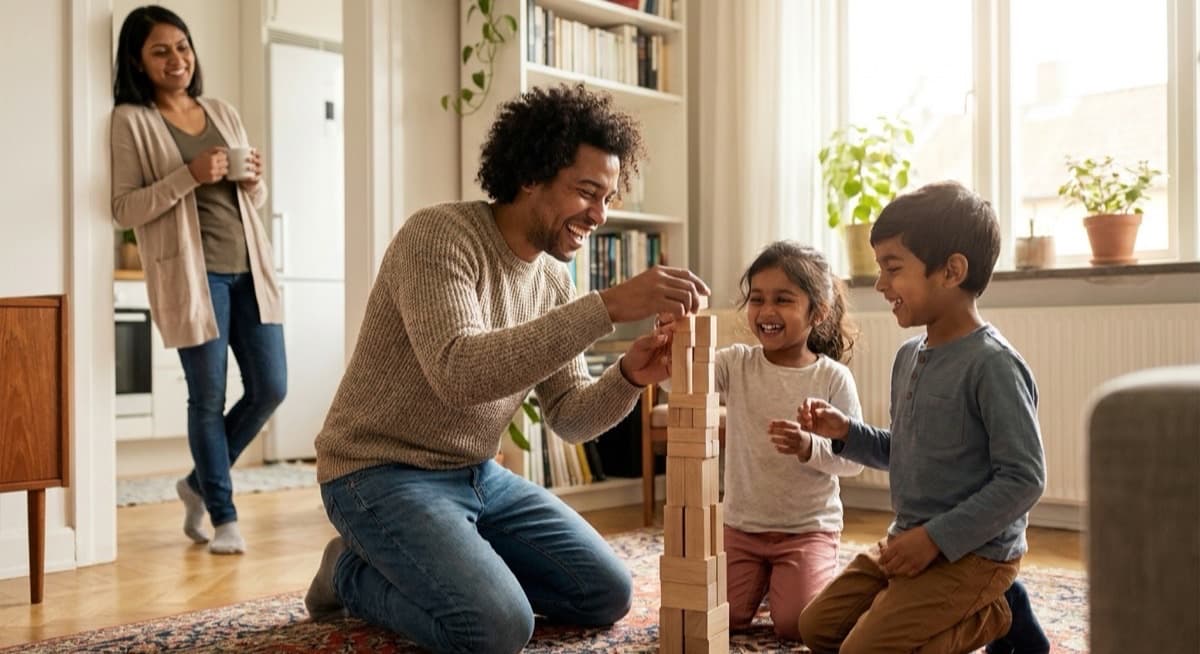
Hannah had done everything right, or so she thought. When she and her husband Mark set up their host family profile in August, she went through the preferences quickly: driving licence, non-smoker, experience with young children, and female. That last box took her half a second. It felt like the normal choice, and nobody questioned it.
Six weeks later, they still had no match. Two candidates they liked had accepted other families, and the ones left didn't feel right. Then Mark mentioned Daniel, a 22-year-old from Brazil who had coached a children's swimming club for three years. His references were glowing and he had applied to them directly. Hannah said no before she had finished reading his profile.
That evening, Mark asked her why. She started to answer and stopped. There was something about their four-year-old daughter and bath time, something about the one shared bathroom upstairs, something about what her mother would say. None of it was a reason she could say out loud, and none of it had anything to do with Daniel.
Hannah wasn't prejudiced. She had simply never thought the questions through, so the default made the decision for her. This guide is about thinking them through: what the rules say about hosting a male au pair, the hesitations families usually keep to themselves, and what changes in practice when your au pair is a young man.
🌍 Rules differ by country. This guide covers Germany and the US, the two programmes our readers ask about most. Always check the current rules with your agency or sponsor.

Schedules, tasks and costs with your au pair, in one app.

Why So Few Families Consider a Male Au Pair
Male au pairs are a small minority of the programme. We could not find an official figure for the share, but agencies that talk about it openly describe it as small, and most host families never interview a man at all.
The reason is rarely a bad experience. It is usually the tick box. Many families filter by gender before they read a single profile, and the filter quietly removes candidates they would have liked.
What the rules actually say
Neither programme sets a gender requirement for au pairs. Here is what the official rules do cover:
| Germany 🇩🇪 | USA 🇺🇸 | |
|---|---|---|
| Gender requirement | None | None |
| Age | 18 at the start, under 27 when the residence permit is applied for | 18 to 26 |
| Private room | The au pair is generally entitled to their own room | A suitable private bedroom is required |
| Checks on the au pair | Not part of the Federal Employment Agency's requirements; ask your agency what it checks | Criminal background check, three non-family references, a personality profile and a personal interview |
| Checks on the host family | Not set out in the Federal Employment Agency's sheet | Host parents and other adults living in the home pass a background investigation |
| Single parents | Explicitly count as host families | Not addressed in the regulation |
The German rules come from the Federal Employment Agency's au pair information sheet, which addresses its applicants as Bewerberinnen und Bewerber, women and men. The US rules are in 22 CFR § 62.31, which refers to the au pair's "his or her home country" and applies every requirement to both.
Key takeaway: The law has no opinion on your au pair's gender. Every hesitation in this post is a family decision, which means it deserves a real answer rather than a default.
Question 1: "Can a Male Au Pair Care for Girls?"
This is the question behind most of the others, and it usually isn't about playing, homework or the school run. It is about intimate care: bathing, changing nappies, helping a small child on the toilet, getting dressed after swimming.
It is a fair question to ask, but it is aimed at the wrong thing. The risk you are trying to manage doesn't depend on gender, and the protection doesn't either. What protects your children is a set of clear body-safety rules that every caregiver follows: grandparents, babysitters, au pairs of any gender.
Write down body-safety rules for every caregiver
Families who handle this well don't make an exception for a male au pair. They write down rules that would apply to anyone:
- Bath time: Which children need help in the bath, and from what age they wash themselves while an adult stays nearby
- Toileting and changing: Who helps, and when the bathroom door stays open
- Getting dressed: Children dress themselves as far as their age allows, and the adult helps with what they can't manage
- Privacy for the child: Older children decide who comes into the bathroom, and the answer is respected
- No secrets: Children know they can tell you anything, and no adult ever asks them to keep a secret from their parents
If a rule would feel wrong applied to a female au pair, it probably isn't a safety rule. If it feels right for everyone, write it into your house rules and go through it with your au pair in the first week.
You can also divide the work differently
Some parents are comfortable with any of this. Others prefer to keep bath time for their younger daughters themselves, at least at first. Both are legitimate, and neither has to be a secret.
If you want to keep certain tasks, say so in the interview. A good candidate will not be offended by a clear arrangement. What damages trust is an unspoken rule he discovers in week three.
Key takeaway: Safety comes from rules, not from gender. Write rules that would apply to any caregiver, then decide openly whether you want to keep particular tasks for yourself.
Question 2: Bathrooms and Privacy in a Smaller Home
In a house with one bathroom, the worry is practical. A young man is now part of the morning rush, the laundry and the late-evening shower queue.
This is really a privacy question, and it applies to any au pair. Our guide to au pair privacy and boundaries covers the room and shared spaces in detail. For a male au pair in a house with daughters or a single mother, a few points are worth settling explicitly.
Settle the practical details before he arrives
- A lock that works: On the bathroom door, and ideally on his bedroom door too
- Time slots: Who uses the bathroom when during the morning rush
- Dressing rule: Everyone crosses the hallway dressed or in a dressing gown, adults and teenagers alike
- Laundry: Everyone handles their own underwear, or it is washed without comment. Agree which
- His room is his: Children knock and wait, and don't go in when he isn't there
None of these rules is specific to men. They make the house comfortable for everyone, and they spare your au pair awkward moments he would never raise himself.
Question 3: Single Parents and an Opposite-Gender Au Pair
For single mothers, the question often sounds like this: "Is it strange to have a young man living in my house when there is no partner?" For single fathers it is the same question with a female au pair, which is far more common but talked about far less.
The honest answer is that it works when the role is professional and clearly bounded, and it gets difficult when it drifts. In a home with only one adult, an au pair can slide into the role of a second one: evening company, confidant, stand-in partner. That risk exists with any au pair, but an opposite-gender pairing makes it more visible to everyone, including the neighbours.
Boundaries that keep the role clear
- Evenings belong to him: When he is off duty, he isn't expected to keep you company
- Keep the relationship professional: You are his host parent, not a friend of the same age, however close in age you are
- No shared nights out: Family outings are fine, bars and parties for two are not
- Guests: Clear rules for overnight guests, for him and for you
- A written duty list: So nobody has to negotiate what counts as work
A written weekly schedule and duty list help most here, because there is no second parent to keep an eye on the balance. In AuPairSync, the tasks and the schedule are the same for every au pair, which makes it easy to see when the job starts to grow beyond what you agreed.
Key takeaway: In a single-parent home, what matters most is a role you have written down. Put the duties and off-duty time in writing, and the arrangement stays professional.
Question 4: "What Will People Say?"
This is the question families are most embarrassed to ask, and it often decides more than the others. Grandparents, other parents at school and neighbours may react with a raised eyebrow.
Give people a simple answer
You don't owe anyone a justification, but a simple, confident sentence helps:
- For relatives: "We chose him because he is the best candidate we interviewed. He coached children for three years."
- For other parents: "That's Daniel, our au pair. He does pickups on Tuesdays and Thursdays."
- For the school or nursery: Add him to the list of authorised pickup people, with a photo, like any other au pair
Reactions usually matter much less once people have met him and seen him at the school gate a few times. Your children will take their cue from you. If you introduce him as a normal part of family life, that is how they will see him.
Prepare him too
A male au pair usually knows he will be noticed. It helps to tell him in advance which reactions he might meet, at the playground, from other parents or from relatives, and that you are on his side. That conversation takes five minutes and saves him a lot of uncertainty.
Question 5: Will He Actually Do Bedtime?
Behind this question is an assumption: that a young man will be great for football in the garden, but less good at comforting a crying toddler, the evening routine or noticing that a child is quietly sad.
Some candidates are, and some aren't. The same is true of female candidates. The assumption can fail both ways: families hire a woman and expect warmth she doesn't bring, or turn away a man who would have been wonderful at bedtime.
Test for it in the interview
Instead of guessing, ask about the parts of the job you care most about. Our au pair interview guide goes through the process in detail. For the emotional side of the job, questions like these work well:
- "Tell me about a time a child was upset and wouldn't calm down. What did you do?"
- "What does a good bedtime routine look like for a three-year-old?"
- "A child says they don't want you, they want their mum. How do you respond?"
- "Which part of childcare do you find hardest?"
Listen for concrete stories, not general statements. Someone who has put small children to bed will describe it in detail. You'll find more questions in our free au pair interview question list.
Check the references properly
References matter even more when you have reservations. Ask references specifically about the situations you are unsure of: "Did he look after young children alone? How did he handle the evenings?" A reference who has seen him with small children will know.
Key takeaway: Don't guess who is good at bedtime. Ask for concrete stories, check the references and base your decision on the person, not the category.
Question 6: Teenagers in the House
Families with teenage daughters sometimes worry about a crush, or about a young man who is only a few years older than their child. Families with teenage sons and a female au pair have the same question, but they ask it much less often.
The answer is the same in both cases: clear, professional boundaries that apply regardless of gender.
- No one-on-one evenings in bedrooms: Homework help happens at the kitchen table
- No private messaging beyond logistics: Pickup times yes, late-night chats no
- Social media: Agree whether and how your au pair and your teenagers follow each other
- A clear line to you: Your au pair tells you if something feels uncomfortable, and knows he won't be blamed for it
Your au pair will usually be relieved to have these rules. They protect him as much as your children.
What Actually Changes With a Male Au Pair
Once the questions are answered, the practical list is surprisingly short. The job, the hours and the duties are the same.
- The hours: In Germany no more than
30 hours per weekand6 hours per day, in the US no more than45 hours per weekand10 hours per day, for every au pair - The duties: The same task list, including cooking, laundry for the children and tidying up
- The house rules: The same rules, plus the body-safety rules above, which you should have anyway
- The introductions: A few extra conversations with relatives, school and neighbours in the first weeks
One thing does change: your candidate pool. If you are open to male candidates, you will see more profiles, and in a season where good candidates are taken quickly, that can shorten your search.
Say it in your profile
If you are open to a male au pair, say so explicitly in your family profile. A male candidate reading a profile that says nothing about it can't tell whether you would consider him, and may not apply. Our guide to writing a host family profile explains how to write a profile that attracts the right candidates.
Your Decision Checklist
Go through these questions with your partner, or on your own if you are a single parent, before you tick or untick the gender box:
- The real reason: Can you name the specific worry behind your hesitation?
- Body-safety rules: Have you written rules that apply to every caregiver?
- Tasks you'd keep: Are there tasks you want to keep yourself, and are you willing to say so in the interview?
- Bathroom and privacy: Are locks, time slots and the dressing rule settled?
- Role boundaries: Especially in a single-parent home: are the duties and off-duty time written down?
- The people around you: Do you have a simple sentence ready for relatives and other parents?
- Interview questions: Have you prepared questions about the emotional side of the job?
- Your profile: Does your profile say whether you welcome male candidates?
If you have good answers to all of these, the gender box stops mattering much.
The Bigger Picture
Most families who host a male au pair don't do it to make a point. They do it because the best candidate they interviewed happened to be a man. The children get a caregiver who is patient, reliable and fun, and they learn along the way that looking after children isn't only a woman's job.
The families who never consider it rarely decided against it. They just never asked themselves the questions. Hannah and Mark did in the end. They had a long video call with Daniel, asked him about bath time and the bathroom and his swimming club, and wrote down the rules they had talked about. Two weeks later, he accepted.
Setting up your au pair year? Download AuPairSync to keep the house rules, the duty list and the weekly schedule in one place, the same for every au pair.