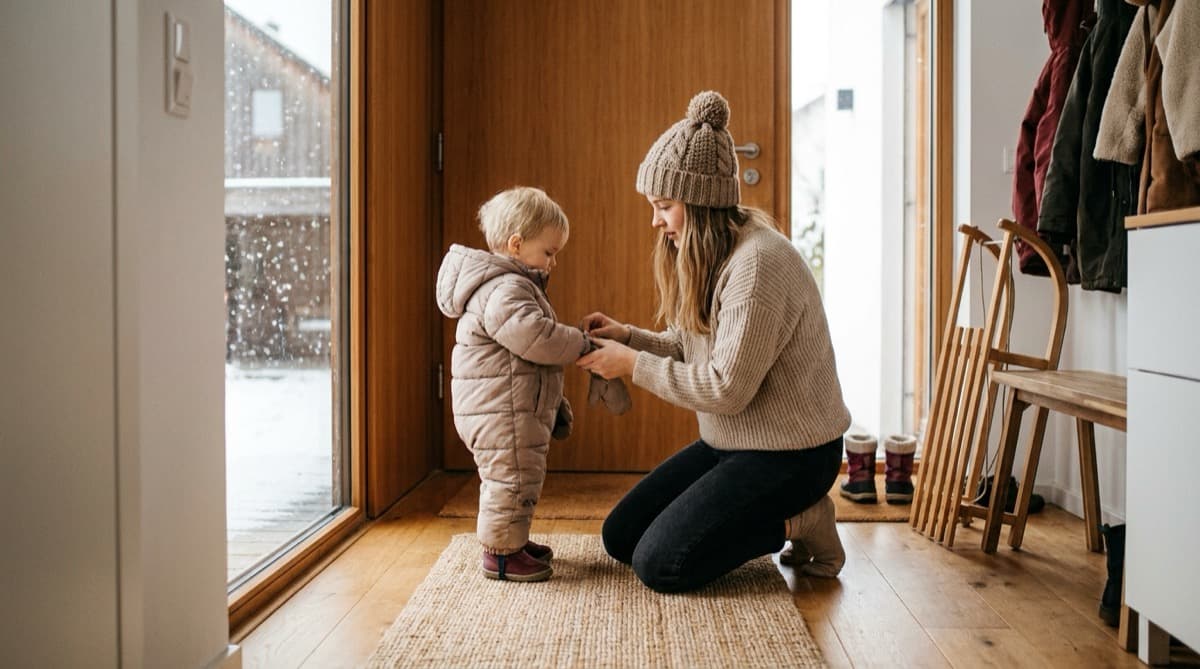
Dana's phone lit up at 6:50 on a January morning with a text from the school district: closed for snow. Down the hall, her au pair, Marta, was already awake. She had grown up in Recife, where the coldest day of the year still needs nothing heavier than a light jacket, and she had been in the house for three months. This was her first real snow.
Marta did what a kind, eager person does. She zipped two-year-old Eli into the biggest snowsuit in the closet, buckled him into his car seat for a quick trip to the pharmacy, and then took him and his seven-year-old brother to the park for an hour. The boys had a wonderful time. Marta noticed that Eli had gone quiet, that his cheeks were very red, and that his mittens had been wet for a while. She was not sure whether that was normal. Nobody had told her what normal looked like.
Nothing bad happened. But Dana, reading the story that evening, realised she had briefed Marta on allergies, bedtimes and the school run, and had never said one word about cold. This guide is the brief she wished she had written: what to put on the children, what to do on a snow day, and which flu-season habits to agree on before the first freeze.
🌍 This guide uses the US as its main example, with notes for Germany. School closures, daycare illness rules and winter driving laws differ by country, state and school, so check your own. This article is general information, not medical advice. Your pediatrician has the final word on any specific child.

Schedules, tasks and costs with your au pair, in one app.

Why Winter Needs Its Own Briefing
An au pair from a warm country has no reflexes for cold. She does not know how fast small hands lose feeling, how little time a toddler needs to get chilled when wet, or that a puffy coat and a car seat do not belong together. Parents carry that knowledge so deeply they never think to say it.
If you hosted through summer, you may have already written a heat, sun and water briefing. Winter deserves the same page, for the same reason: the dangers are ordinary, and the person in charge of the afternoon has never met them.
What This Guide Covers (and What It Leaves to Others)
- Dressing for the cold: layers, wet clothes and when to come inside
- The car seat and winter coat rule: the one winter habit that is easy to get wrong
- Snow, ice and sledding: simple supervision rules
- A snow-day plan: who decides, who covers, what the au pair's hours look like
- Flu-season basics: handwashing, staying home and who decides about medicine
The day-of playbook for a sick child, with call-now symptoms and the escalation ladder, lives in our sick-child protocol. We do not repeat it here.
Dressing Kids for the Cold
Most winter mistakes are dressing mistakes, and they run in both directions. An au pair who is cold herself may over-bundle a child. One who has never needed a hat may forget it.
Layers, Not One Big Coat
The American Academy of Pediatrics puts it plainly: wearing several thin layers keeps kids warm and dry, and insulated boots, mittens or gloves and a hat are part of the kit (AAP, Winter Safety). German advice says the same thing in different words: the Stiftung Kindergesundheit recommends several thin layers over one thick sweater and warns against dressing children too warmly out of caution, because they then sweat more and chill more easily (Stiftung Kindergesundheit, Newsletter 11/2016).
A layering card for the hallway wall:
| Layer | What it does | Examples |
|---|---|---|
| Base | Sits against the skin, stays dry | Long-sleeve top, leggings, thin socks |
| Middle | Holds warmth | Fleece, wool sweater |
| Outer | Blocks wind, rain and snow | Waterproof jacket or snowsuit |
| Extremities | Fingers, toes, ears | Hat, mittens, insulated boots |
Two Rules an Au Pair Can Apply Without Guessing
- Wet means change. The AAP says children should change out of any wet clothes right away. Wet mittens and socks are the usual culprits, so put a spare pair in the bag every time.
- Indoor breaks are part of the plan. The AAP advises a warm place for regular indoor breaks. In practice: a half hour out, then in for a warm drink and dry hands, then out again if everyone wants to.
The AAP also says that playing outside in temperatures or wind chills below -15°F (about -26°C) should be avoided, because uncovered skin can freeze within minutes. Most days will never come near that. It is still a good number to write on the card, because it turns "is it too cold?" into a thing she can check on her phone.
Key takeaway: The question is not "is the child wearing a coat?" It is "is the child dry, covered at the hands, feet and head, and able to tell me when they are cold?" A two-year-old often cannot.
Little Ones Overheat Too
Over-bundling is a real mistake, not a harmless one. A child sweating inside a snowsuit ends up with damp clothes, and the AAP's rule for damp clothes is to change them right away. For babies, the AAP's winter car seat guidance suggests about one more layer than an adult would wear, with the top layer removable so the baby does not overheat once the car warms up (AAP, Winter Car Seat Safety Tips). Ask your au pair to look at the whole child every so often, coat included.
The Car Seat and Winter Coat Rule
If you only teach your au pair one thing from this guide, make it this one. It is counterintuitive, and it matters on every winter drive.
Why Puffy Coats Don't Belong Under the Harness
The AAP's advice is that bulky clothing, including winter coats and snowsuits, should not be worn under a car seat harness. In a crash, the padding flattens and leaves slack in the straps, so a child can slip through. The AAP also says nothing bulky should go between the child's body and the harness straps (AAP, Winter Car Seat Safety Tips).
Germany's ADAC reaches the same conclusion. Its advice is to buckle children in without a winter jacket where possible, and to keep the belt directly against the body. If the child is cold, it suggests covering them with a pre-warmed blanket (ADAC, Autofahren mit Winterjacke).
The Hallway Routine
- Coat off before the seat. Take the puffy coat or snowsuit off at the car, not in the driveway after the straps are done.
- Thin layers underneath. A fleece or a sweater is fine; the AAP lists thin layers as the workaround.
- Tighten and test. The straps should sit snugly against the chest. If you can pinch webbing at the shoulder, tighten them.
- Warmth goes on top. Lay the coat backwards over the buckled harness, or tuck a blanket over it.
- Hat and mittens stay on. They are not a bulk problem.
Walk your au pair through this once in the driveway, with the child. Ask her to do it herself while you watch. A rule she has practised once is a rule she will remember on a dark morning.
Important: This applies to every car trip, including the five-minute run to school. Most short trips are where the coat stays on, because it seems silly to take it off for so little.
Snow, Ice and Sledding
Snow is delightful and, for a first-timer, mildly confusing. A few agreed rules stop it from becoming a problem.
Sledding
The AAP's sledding advice is specific enough to copy straight onto your card (AAP, Winter Safety):
- Feet first or sitting up, not lying head-first, which may prevent head injuries
- Consider a helmet to prevent serious head injury
- Steerable sleds, not snow disks or inner tubes, where there is less control over where the sled goes
- Supervision: children under 12 should always be supervised while sledding
For your own house, add what only you know: which hills are fine, which one ends at a road, and who to call if a child falls and cries for longer than a normal tumble would.
Snow Forts and Tunnels
The AAP says to supervise children when they build snow forts or tunnels, because a collapse is a suffocation risk, and to make sure they leave an opening to exit. Make that a one-line rule for your au pair: no tunnels without an exit, and no digging when she cannot see them.
Ice and Frozen Water
A frozen pond looks like a playground. Decide in advance and say it out loud: no stepping onto frozen ponds, lakes or streams, whatever the neighbours' children are doing. We give no ice-thickness figure here. For an au pair on her own with the children, the simple rule is no.
Cold Warning Signs
The AAP describes frostbite as skin that may hurt or burn, then quickly go numb, and may turn white or pale gray and form blisters. Because numbness hides the injury, a child may not complain. If you suspect it, bring the child indoors and warm them gently. Do not rub the area, soak it in warm, not hot, water for 20 to 30 minutes, and call the pediatrician if pain or numbness lasts (AAP, Winter Safety).
For hypothermia, the CDC lists shivering, extreme tiredness, confusion, clumsy hands and sleepiness in adults. In infants, it names bright red, cold skin and very low energy, and says to seek immediate medical attention for signs of hypothermia (CDC, Recognizing Hypothermia). The takeaway for an au pair: if a child looks wrong in the cold, go in, call you, and call emergency services first if it looks serious.
A Snow-Day Plan Everyone Can Follow
A snow day is a scheduling event before it is a safety event. When schools close at 6:50 a.m., a house with no plan gets chaos by 7:15.
Decide Who Decides
| Question | Who owns it | Why |
|---|---|---|
| Is school closed or delayed? | Parent confirms, au pair also checks the school's channel | One source of truth, two sets of eyes |
| Do the kids go outside? | Au pair, within the card's rules | She is there and can see conditions |
| Does the au pair drive? | Parent decides, agreed in advance | Winter driving depends on her experience and your insurance |
| Do her hours change? | Parent and au pair together | Extra hours need a clear answer |
The Hours Question
A snow day often means a full day with children who would normally be at school. In the US, program rules cap an au pair's working week at 45 hours and a day at 10, and our guide to the 45-hour, 10-day rule explains how quickly an unplanned day pushes a week over. Decide before the first snow: if school closes, what does she work, what does she not, and how is the time evened out? If you are in Germany, the same logic applies to your agreed daily and weekly limits.
Driving, Pickups and Late Starts
A late start or early dismissal moves every pickup in your week. Our after-school pickups guide covers the handover details. For winter, add three lines:
- Who may drive in snow: if your au pair has never driven on ice, the answer is "not yet", and a lift or a taxi is the plan.
- What the backup is: a neighbour, a grandparent, or a parent working from home that day.
- When the decision is made: for example, "we decide by 7:00 a.m., and I will text you."
Power Cuts and Storms
Winter storms can bring outages. Your family emergency plan should cover the house with no heat or no light, and your emergency contacts sheet should be where she can find it without a signal.
Flu-Season Basics
Colds and flu go around every winter, and a house with children and a newly arrived au pair is a good place for them to travel. A few habits do most of the work, and none of them is complicated.
Handwashing
The CDC says to wash your hands often with soap and water, and to use an alcohol-based hand rub if soap and water are not available (CDC, Preventing Flu). Make it specific: when you come in, before food, after the bathroom, and after nose-wiping. A small stool by the sink and a song for the little ones help more than a lecture.
Staying Home
For flu, the CDC says to stay home for at least 24 hours, until your symptoms are improving overall and you have not had a fever without fever-reducing medicine. The same logic matters for your au pair: she should not feel she has to work a shift while ill. Our guide on when your au pair is sick covers the plan and the pay.
School and daycare rules are often stricter than the CDC's. Ask for the school's written policy and put it with your sick-child protocol. If a child is ill, that protocol covers who decides what.
The Flu Shot
The CDC recommends an annual flu vaccine for everyone 6 months and older, ideally by the end of October (same CDC page). For the children, that is a conversation with your pediatrician. For your au pair, it is worth asking whether her health plan covers it; our guide to au pair health insurance and doctor visits explains how the program plan usually works.
Medicine Is the Parents' Decision
Whether a child with a cold or fever gets any medicine, which product and how much, is for the parents and the pediatrician to decide, not the au pair. She gives only what you have written down. Our guide to putting allergies and medications in writing shows how to set that up. This article deliberately gives no doses.
Key takeaway: Wash hands, stay home when ill, and keep medicine decisions with the parents. Agree these in October and nobody has to improvise in February.
Where AuPairSync Helps
Two things in this guide are easy to agree on and hard to keep track of: the snow-day changes, and who gave what when someone is ill. A school closure is quick to put in the shared calendar, so both parents and the au pair see the new plan and the changed pickup in one place. And if you switch on the optional medication log in a child's profile, parents and au pairs can record each dose they give, with the time and the amount, so the next adult does not have to guess whether the morning dose happened. The parents decide what is given. The log only records it.
The Winter Brief Checklist
Put this on a single page and hand it over before the first freeze:
- Layering card: base, middle, outer, hat, mittens, boots, spare dry pair in the bag
- Car seat rule: coat off, thin layers on, warmth over the harness
- Cold limits: the wind chill you will not go out in, and the signs to come in
- Sledding and snow rules: feet first, steerable sled, no tunnels without an exit, no frozen water
- Snow-day plan: who confirms school, who decides about driving, how hours are handled
- Flu basics: handwashing, stay-home rule, the school's policy, the flu shot question
- Medicine: parents decide, au pair gives only what is written down
- Contacts: pediatrician, both parents, a backup adult
Winter Is a Welcome
It is easy to treat a winter brief as a list of dangers. It is also a way of telling someone from far away that you want her to enjoy the season. For many au pairs, the first snow is one of the moments they will describe to their families for years.
Dana wrote the card the next weekend. They walked through the car seat routine together in the driveway, and Marta practised it twice with Eli giggling in the back. The next snow day, she sent a photo of both boys in dry mittens beside a lopsided snowman, with a short text: "Back inside for hot chocolate. Dry socks on."
Hosting an au pair this winter? AuPairSync keeps the family calendar, children's profiles and optional medication log in one place, so a snow day starts with a plan.