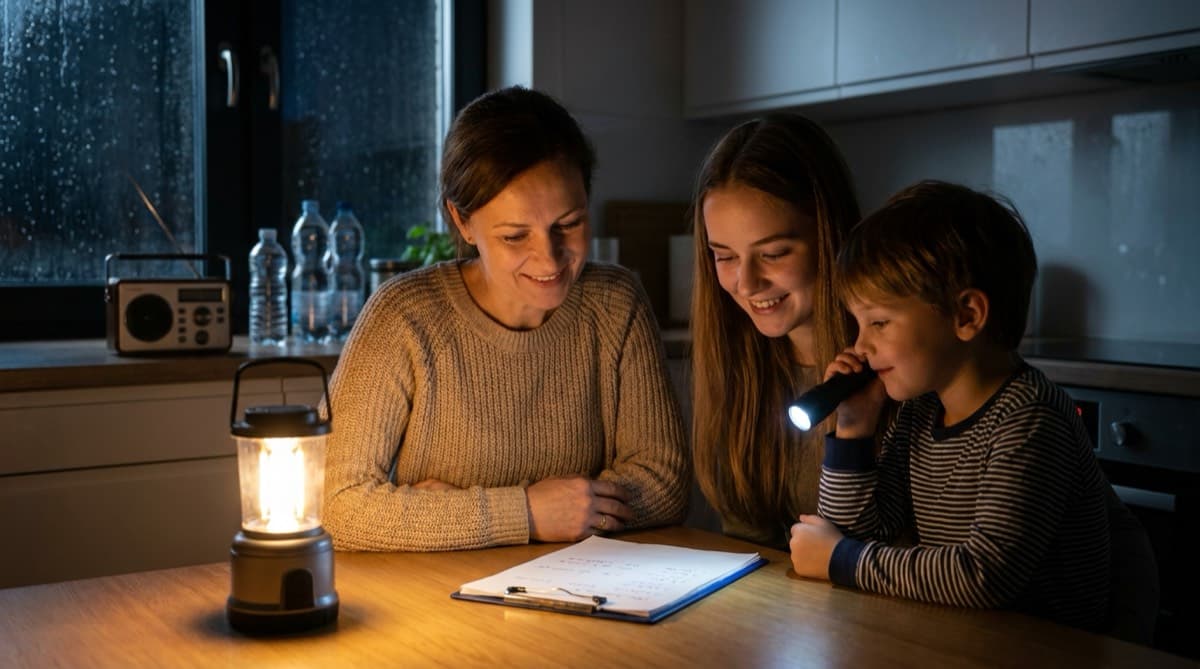
Jen had done everything right, or so she thought. Before Valentina arrived from Bogotá, she had printed the contact sheet, walked her through the medicine cabinet and saved the paediatrician's number in her phone. What Jen had never written down was an au pair emergency plan for the day the whole house stopped working.
That day came on a Thursday in late September. A tropical storm moved up the coast faster than forecast. Jen was on a hospital shift that could not be left, her husband Marcus was stuck in traffic on a flooded highway, and at 4:40pm the power went out with both kids at home.
By 6pm Valentina's phone was at 18 percent. Calls to Jen didn't connect, and texts sat on "sending". The sump pump in the basement had stopped. A neighbour knocked to say the county was recommending people on their street move to a shelter at the high school. Valentina had no idea whether that meant her, whether she was allowed to take the kids somewhere without asking, or whether she should wait until someone answered.
She waited. For two hours, in the dark, with a six-year-old asking when the lights would come back.
Nothing bad happened in the end. But Valentina wasn't stuck because she lacked courage or common sense. She was stuck because every plan in that house had quietly assumed a parent would be standing in the kitchen when things went wrong.

Plan your au pair week together, in one app.

Why "they have my number" is not an emergency plan
Most host family preparation is built around one scenario: something happens, the au pair calls you, you tell them what to do. That model works for a scraped knee or a missed bus. It breaks in exactly the situations where you need it most, because storms, outages and wildfires take down the thing the model depends on: the phone call.
When a storm hits a region, three things tend to happen at once. Mobile networks get congested as everyone calls everyone. Roads close, so the parent who is "20 minutes away" is suddenly two hours away. And the au pair, often in their first year in the country, has no local memory of how bad this kind of weather gets.
Key takeaway: An emergency plan for a caregiver has to work on the assumption that you cannot be reached. If it only works when you pick up the phone, it is a contact list, not a plan.
What this post covers, and what it doesn't
This guide is about household emergencies: severe weather, power and internet outages, evacuation, school lockdowns and losing contact with the parents. It deliberately skips the medical side. For emergency numbers, first aid and what to do after a fall or allergic reaction, our guide to emergency preparedness for au pairs covers the contact sheet in detail. Build that first. This plan sits on top of it.
Which emergencies your au pair could actually face
The right plan depends heavily on where you live. An au pair from Madrid may never have seen a tornado warning. One from Manila may know more about typhoons than you do, but nothing about ice storms. Start by being honest about your local risks.
Regional risks at a glance
| Region | Most likely household emergency | Typical season |
|---|---|---|
| US Southeast and Gulf Coast | Hurricanes, flooding, multi-day power loss | June to November, peak around 10 September |
| US West | Wildfires, smoke days, planned utility shut-offs | Summer to late autumn |
| US Midwest and Plains | Tornadoes, ice storms, blizzards | Spring for tornadoes, winter for ice |
| US Northeast | Nor'easters, heavy snow, coastal flooding | Autumn to early spring |
| Germany | Severe thunderstorms, heavy rain and flash floods, winter storms | Summer storms, autumn and winter gales |
Country-specific section. Warning systems and emergency numbers differ by country. The table below covers the United States and Germany.
| USA 🇺🇸 | Germany 🇩🇪 | |
|---|---|---|
| Emergency number | 911 | 112 (fire and ambulance), 110 (police) |
| Official warnings on the phone | Wireless Emergency Alerts, on by default | Cell Broadcast, on by default |
| Warning app | FEMA app, plus your county's alert sign-up | NINA (federal warning app) |
| Weather service | National Weather Service | Deutscher Wetterdienst, WarnWetter app |
Sit down with your au pair in the first week and install the warning app on their phone, in a language they understand. Many county alert systems in the US let you register more than one number, so sign theirs up too.
The written plan: five things that must not live only in your head
The heart of the plan is short. It should fit on two sides of paper, and your au pair should be able to find any part of it in under a minute. Here is what belongs in it.
1. Where the shut-offs are
When water is coming through the ceiling, nobody wants to learn where the main valve is. Walk your au pair to each of these and add a photo of each to the plan:
- Main water valve: where it is, which way to turn it, and whether it needs a tool.
- Breaker panel or fuse box: how to reset a tripped breaker, and which breaker is the fridge.
- Gas: where the meter is, but with a clear rule. If they smell gas, they leave the house with the children, don't touch light switches and call from outside. Turning the gas off is your job or the utility's, not theirs.
- Sump pump and backup: if you have one, what it sounds like when it stops and whether there is a battery backup.
- Garage door manual release: without power, many electric doors won't open. If the car is inside, this matters.
2. The meeting points
A meeting point is where everyone goes if they can't stay at home and can't reach each other. You need two, and your au pair should have physically been to both.
- Near home: somewhere within walking distance, such as a neighbour's house or the corner by the school.
- Out of the neighbourhood: somewhere safe if the whole area has to leave, such as a friend's home on higher ground or the official shelter for your zone.
For hurricane or flood regions, check whether your address is in an evacuation zone through your county's emergency management website. Write the zone name on the plan. Evacuation orders are announced by zone, and "Zone B is evacuating" means nothing to someone who doesn't know they live in Zone B.
3. The out-of-area contact
This is the part almost every family skips, and it is the one that would have helped Valentina most. Choose one person who lives far away, in another region or even another country, and make them the family's check-in point.
When local networks are overloaded, calls and texts to a distant number often get through when local ones don't. Everyone in the family, including the au pair, agrees: if we can't reach each other, we each tell the out-of-area contact where we are and what we are doing. That person becomes the switchboard.
- Pick someone reliable and reachable: a grandparent, a sibling, a close friend.
- Tell them they have the job: they should know what to do if an au pair they have never met texts them.
- Save the number in every phone, including the children's if they have one.
4. The supplies and where they are
A go-bag and a home kit don't need to be elaborate. They need to exist, and your au pair needs to know where they are without asking.
- Light: torches with batteries, a battery lantern. Candles are a fire risk with small children around.
- Power: a charged power bank per adult, plus a car charger.
- Water and food: drinking water for at least three days and food that doesn't need cooking.
- Radio: a battery or wind-up radio for official updates when the internet is down.
- Children's essentials: nappies, spare clothes, comfort toys, a paper copy of any routines.
- Documents: copies of IDs and insurance details, including the au pair's own.
Any medication that needs to stay cold, or that a child cannot miss, needs its own line in the plan. How to document that is covered in our guide to putting allergies and medications in writing.
5. The escalation rule
This is the most important sentence in the whole document, so write it in bold at the top: call 911 first, tell us second. In Germany, that is 112.
Au pairs are often reluctant to call emergency services without permission. They worry about cost, about overreacting, about getting the family in trouble. Remove that worry in writing.
Key takeaway: Your au pair should never have to decide whether they are allowed to get help. Put the permission in the plan, in plain words, before it's needed.
The one decision an au pair must never make alone
Go back to Valentina in the dark. The hardest part of her evening wasn't the outage. It was the question she had no way to answer: am I allowed to leave with the children if I can't reach the parents?
That is the decision no caregiver should have to make on their own. So make it for them, in advance.
Write the rule down
- If authorities order an evacuation, leave. Don't wait for us. Take the children and the go-bag, go to the meeting point or shelter, and tell the out-of-area contact.
- If you feel unsafe and can't reach us, you decide. Whatever you decide in good faith to keep the children safe, we will back you.
- Tell us when you can, not before you act. A text saying "at the high school shelter, all fine" is enough.
Families sometimes worry this gives the au pair too much authority. In practice it does the opposite. It removes the grey zone where a young adult sits frozen, trying to guess what you would want, while the situation gets worse.
Power and internet outages: the long evening at home
Most household emergencies are not dramatic. They are a power cut that lasts six hours on a school night. Your au pair needs a plan for that, too.
The first 30 minutes
- Check whether it's just your house: look at the neighbours' windows. If it's only you, check the breaker panel.
- Report the outage to the utility, using the number or app written on the plan.
- Switch to battery light, and put a torch in each child's room before it gets dark.
- Save phone battery: low power mode, brightness down, no streaming.
Keeping the food and the house safe
A closed fridge keeps food safe for about 4 hours. A full freezer holds for about 48 hours, or about 24 if it's half full. The rule for your au pair is simple: keep the doors shut, and when in doubt, throw it out.
If you own a generator, the rule is non-negotiable: never indoors, never in the garage, never near an open window. Carbon monoxide has no smell. Make sure your carbon monoxide alarms have battery backup and your au pair knows what they sound like.
Keeping the kids calm
Children read the adult in the room. A calm au pair with a plan makes an outage feel like an adventure.
- Name it early: "The power is out, we have torches, and we have a plan."
- Keep the routine: dinner at the same time, bath if the water heater still works, the same bedtime story by lantern light.
- Give them a job: the seven-year-old is in charge of torches, the four-year-old checks the teddy bears.
- Bank a few screen-free games: cards, shadow puppets, a story where everyone adds a sentence.
Key takeaway: The difference between a scary outage and a memorable one is almost entirely whether the adult in charge knows what happens next.
When the internet is down, but the phone still works
Many au pairs rely on Wi-Fi calling and messaging apps to stay in touch. When home internet fails, those can stop working even while the phone has signal. Make sure your au pair has enough mobile data on their plan for an evening without Wi-Fi, and knows that an ordinary SMS may get through when a messaging app shows "connecting".
School lockdowns and closures
A school lockdown is one of the most stressful situations for any caregiver, and au pairs are often not on the school's communication lists at all. The time to fix that is September, not the day it happens.
Before anything happens
- Add the au pair to the authorised pickup list at every school and childcare setting, with their full name as it appears on their ID.
- Sign them up for the school's alert texts or app, if the school allows a second adult.
- Find out where the school's reunification site is. Many US districts send families to a different building after a lockdown.
During a lockdown
The instructions are usually counterintuitive, so write them out:
- Don't go to the school unless the school tells families to come. Arriving adults block emergency services.
- Follow the official channel, not rumours in group chats.
- Bring ID to the reunification site. Children are only released to people on the list.
- Tell the out-of-area contact and the parents where you are going.
Unplanned closures for storms or snow are the milder version. Decide in advance whether a surprise closure day counts as extra hours and how it's handled, so nobody has to negotiate that at 6am.
Wildfire smoke and extreme weather days
Not every emergency involves leaving the house. Smoke days, heat domes and ice storms are about keeping children safely inside.
- Smoke: check the Air Quality Index. Children count as a sensitive group, so keep outdoor play inside when the index is above
100. Close windows and set the air conditioning to recirculate. - Planned utility shut-offs: in wildfire areas, utilities may cut power in advance during high winds. Register the au pair's number for those alerts too.
- Thunderstorms and tornadoes: know the safest room in the house, usually the lowest floor, an interior room with no windows.
- Ice and snow: no driving unless it's an emergency. The rules in our guide to au pair driving and car rules should say who decides when roads are unsafe.
Heat is its own topic, covered in our summer safety guide.
When you can't reach each other: the communication plan
Back to the core problem: the phone call that doesn't connect. A good communication plan has layers, so that when one fails, the next one takes over.
The communication ladder
| Step | What to try | Why |
|---|---|---|
| 1 | Short SMS to both parents | Texts use far less network capacity than calls |
| 2 | One call to each parent | Only after texts, and keep it brief |
| 3 | Message the out-of-area contact | Long-distance often works when local doesn't |
| 4 | Post a status in the family's shared channel | Everyone sees it when their phone reconnects |
| 5 | Leave a paper note at home if you leave | "Gone to the shelter at the high school, 7pm" |
Agree on check-in times, too. "If we haven't heard from each other, everyone checks in on the hour" beats a stream of anxious retries that drain the battery.
This is where having the plan in one shared place matters. A binder is useless when it's in a flooded basement or you're across town. In AuPairSync, an announcement marked as an emergency goes out to everyone in the family with a push notification, so the "we're at the shelter" message reaches every phone once it's back online, without anyone having to guess which chat thread to check.
Don't forget the au pair's own people
Your au pair's family will see the storm on the news before your au pair has a chance to call. Agree that your au pair sends home a short "I'm safe" as soon as they can. In the US, also agree who tells the local coordinator, since agencies want to know when a placement is affected by a disaster.
Key takeaway: Decide the order of messages in advance. When everyone knows who hears first, nobody wastes battery calling the wrong person.
Practise it once, in daylight
A plan read once in August will be half-forgotten by January. The fix is a 30-minute practice run, on a calm afternoon, early in the placement.
- Walk the shut-offs: water, breakers, garage door release. Let your au pair actually turn the valve.
- Find the kit in the dark: turn the lights off and ask your au pair to find the lantern and power banks.
- Walk to the near meeting point with the children.
- Send a test message to the out-of-area contact.
- Read the escalation rule out loud together, including the evacuation rule.
Repeat a shorter version at the start of each risk season: before hurricane season, before winter, before wildfire season. Keep the plan itself with your other household information. If you've written a family handbook for your au pair, this plan should be its first page, not an appendix. Store a copy in your shared document storage so it's on every adult's phone, not just the fridge.
Your household emergency plan checklist
- Warnings: official warning app installed on the au pair's phone, county or utility alerts registered.
- Shut-offs: water, breakers, gas rule, sump pump, garage door release, with photos.
- Meeting points: one near home, one outside the neighbourhood, both visited.
- Evacuation zone: looked up and written on the plan.
- Out-of-area contact: chosen, briefed and saved in every phone.
- Supplies: light, power banks, water, food, radio, children's essentials, document copies.
- Escalation rule: "call 911 first, tell us second" written at the top.
- Evacuation permission: "if authorities say leave, leave, don't wait for us".
- School: au pair on every pickup list, signed up for alerts, reunification site known.
- Communication ladder: agreed, including check-in times and the au pair's own family.
- Practice run: done once, repeated each season.
A plan is a gift of permission
The practical parts of this plan matter: the valve, the lantern, the power bank. But the most valuable thing in it is quieter. It is permission, written down in advance, for a young person far from home to act without waiting for you.
Jen and Marcus built their plan the weekend after the storm. It took an afternoon and fit on two pages. The next outage, in January, lasted nine hours. Valentina texted the out-of-area contact, made pasta on the gas hob by torchlight and read the kids three chapters of their book. When Jen finally got through, the message was already waiting: "All fine. Candles banned. Kids asleep."
Setting up your household for storm season? Download AuPairSync so your emergency plan, contacts and family announcements are on every phone in the house before the lights go out.