
Megan thought she had done the math. Her au pair, Camila, would cover mornings from 7:00 to 9:00, then the afternoon stretch from 2:30 until the kids were down around 7:30. Five days a week. It felt reasonable — generous, even, with that long midday gap free. She'd read that the J-1 program allowed 45 hours per week and 10 hours per day, and nothing on her calendar came close to ten hours in a single day.
Then a coordinator call in month two asked a simple question: how many hours was Camila actually working? Megan added it up for the first time. Two hours in the morning, five in the afternoon — seven hours a day, times five, was 35. Fine. But she'd forgotten the Tuesday and Thursday activity runs, the Saturday morning she'd asked Camila to cover so she could get to a work thing, and the two evenings a week the toddler refused to sleep before 8:30. The real number was closer to 44 — and on the weeks with a sick kid, over 45.
Nobody had done anything wrong on purpose. Megan wasn't trying to overwork anyone; she genuinely believed she was well inside the limits. The problem was that she'd been counting the schedule, not the hours — and the two rules that govern an au pair's week interact in ways that catch almost every first-year host family off guard.
That's what this guide is for. Not the general "build a good routine" advice — that's the au pair schedule guide. This one drills into the legal hour-counting itself: which hours count, which don't, how the 45-hour and 10-hour caps quietly collide, and how to build a week that stays compliant without a spreadsheet and a stopwatch.
🇺🇸 This guide covers the U.S. J-1 au pair program specifically. Hour limits, days-off rules, and stipend requirements are set by the U.S. Department of State (22 CFR 62.31) and differ from au pair programs in Germany, France, or the UK. Your sponsor's handbook is the authority on your specific placement — always confirm the details there.

Plan your au pair week together, in one app.

The Two Numbers That Govern the Week
Every J-1 host family is handed two figures during matching, usually without much explanation of how they work together. Understanding that interaction is the whole game.
The Daily Cap: 10 Hours
An au pair may provide childcare for no more than 10 hours in any single day. This is a hard ceiling, not a target. It exists so that no single day becomes a marathon — a fourteen-hour Saturday because both parents are traveling is not permitted, no matter how you'd like to balance it out later.
The Weekly Cap: 45 Hours
Across the whole week, an au pair may work no more than 45 hours. Not 45 on average, not "usually 45" — 45 as an absolute weekly maximum. A regular standard au pair works up to this limit; the EduCare option is different (up to 30 hours per week, aimed at families with school-age kids), so make sure you know which type you actually have.
Key takeaway: The 10-hour day and the 45-hour week are two separate limits, and you have to stay under both at once. Meeting one does not protect you on the other. The trap is assuming that if no day hits ten hours, the week must be fine.
Why the Two Caps Collide
Here's the arithmetic that surprises people. Five days at the full daily maximum of ten hours each is fifty hours — already five hours over the weekly cap. In other words, you can never use the 10-hour daily limit on all five working days. The daily cap tells you how tall any single day can be; the weekly cap quietly forces most of your days to be shorter than that.
| If you work... | Hours/day | Total | Compliant? |
|---|---|---|---|
| 5 days at 10 hours | 10 | 50 | ❌ Over the 45 cap |
| 5 days at 9 hours | 9 | 45 | ✅ Exactly at the limit |
| 4 days at 10 + 1 day at 5 | 10 / 5 | 45 | ✅ At the limit |
| 5 days at 8 hours | 8 | 40 | ✅ Comfortable buffer |
The families who stay compliant treat 45 as the number they build backward from — deciding how many hours they genuinely need, then distributing them — rather than filling each day toward ten and hoping the week adds up. The schedule checker does the adding up: enter the planned hours for each day and it shows which days break the rules.
Which Hours Actually Count
Almost every accidental overage comes from miscounting what "on duty" means. The rule of thumb is simple: if your au pair is responsible for the children, the clock is running — whether or not the work feels intense in that moment.
Hours That Count
- Active childcare — feeding, dressing, bath time, homework help, play, discipline
- Driving the kids — school runs, activity drop-offs and pickups, the ride and the wait
- Supervising downstairs while kids nap — if your au pair must stay available, they're working
- Meals with the children — if they're supervising, it counts, even at the family table
- Playdates and activities — including time spent watching from the sidelines
- On-call or "keep an ear out" time — if they can't leave the house, they're on duty
Hours That Don't Count
- Genuine free time — the midday gap, evenings off, real time to themselves
- Educational coursework — class time and study for the required credit hours are theirs, not yours
- Sleep — including overnight, unless you've explicitly scheduled and counted a night duty
- Their own errands, social life, and travel on days and hours off
Key takeaway: "Keeping an ear out for the baby while I run to the store" is working time, not a favor. The moment your au pair can't leave the house or fully switch off, the clock is running — and it counts toward the 45.
The Grey Zones Where Hours Hide
The overages that push families past 45 almost never come from the obvious blocks. They come from the edges:
- The nap that isn't a break — a sleeping toddler still needs a responsible adult in the house. That's on-duty time, not free time, unless another adult has taken over.
- The "quick" weekend favor — an hour here, ninety minutes there, asked casually and never written down, is exactly how a 40-hour week becomes a 46-hour one.
- Travel time with kids — a 25-minute drive each way to soccer, plus the practice, is real working time even if the au pair is "just" watching.
- The bedtime that ran long — "you're done when the kids are asleep" turns a planned 7:00 finish into 8:30 on the hard nights. Count the actual time, not the intended time.
The Days-Off Rules That Live Alongside the Caps
The 45/10 hour limits don't stand alone. The program pairs them with mandatory rest (22 CFR § 62.31), and a schedule that ignores the days-off rules isn't compliant even if the hours add up perfectly.
| Rule | The requirement | What it means in practice |
|---|---|---|
| Days off | 1.5 days per week | At least one and a half full days with zero childcare, every week |
| Free weekend | 1 complete weekend per month | One full Saturday-and-Sunday off, not just a Sunday |
| Vacation | 2 weeks paid per year | Paid time off, ideally discussed in the first month |
| Daily cap | 10 hours per day | No single day exceeds ten on-duty hours |
| Weekly cap | 45 hours per week | The whole week stays at or under 45 |
Build the Rest In First, Not Last
The families who get this right schedule the days off before they distribute the working hours — the reverse of what most people do. If Camila's day and a half off is locked in as Saturday plus Sunday morning, the remaining hours have to fit around it, which naturally keeps the week honest.
Regulations change and sponsors differ. The figures above reflect the standard J-1 framework, but your sponsor sets the specifics and can require more generous terms. Read your sponsor handbook and ask your local coordinator before finalizing any schedule.
Why You Can't Just Pay for the Extra Hours
This is the single biggest misconception host families carry over from employing a nanny: the assumption that hours past the cap are simply overtime you can pay for. They are not.
An au pair is a cultural-exchange participant, not an hourly employee. There is no overtime mechanism in the J-1 program. The 45-hour ceiling is a program rule, and going past it is a compliance violation, not a billable extra. You cannot buy your way to a 50-hour week by offering more money.
What This Means When You Genuinely Need More Coverage
- Adjust within the week, don't add to it — if Wednesday ran long, trim Thursday so the weekly total holds
- Plan babysitting inside the 45 hours — an evening outside the schedule still counts toward the week. Ask first and accept a no, as our guide to babysitting beyond regular hours explains
- Line up backup childcare — a grandparent, a neighbor, a sitter — for the weeks your family needs coverage the au pair legitimately can't provide
- Right-size the match — if you consistently need more than 45 hours, an au pair may not be the right childcare model for your family
Key takeaway: There is no such thing as au pair overtime. If a week is heading past 45 hours, the answer is always to move hours around or bring in outside help — never to work the au pair longer and pay extra.
Building a Week That Stays Under Both Caps
Enough theory. Here's what a compliant, humane week actually looks like when you count carefully. This is a split-shift week totaling exactly 44 hours — a deliberate one-hour buffer under the cap for the nights that run long.
| Day | Morning | Afternoon/Evening | Daily total |
|---|---|---|---|
| Monday | 7:00–9:00 | 2:30–7:30 | 7 |
| Tuesday | 7:00–9:00 | 2:30–8:00 | 7.5 |
| Wednesday | 7:00–9:00 | 2:30–7:30 | 7 |
| Thursday | 7:00–9:00 | 2:30–8:00 | 7.5 |
| Friday | 7:00–9:00 | 2:30–7:30 | 7 |
| Saturday | Off | 6:00–9:00 (date night) | 3 |
| Sunday | Off | Off | 0 |
| Week | 44 |
Notice what this schedule does: it never touches ten hours on any single day, it keeps a full day and a half off (Saturday day plus all of Sunday), and it leaves a one-hour cushion so a rough bedtime doesn't tip the week over. The arrival-week no-childcare days work the same way — you start under the caps and build up, never the reverse.
Turn the Schedule Into a Written Agreement
A compliant week only stays compliant if both sides can see it. The moment the schedule lives only in your head, the "quick favors" creep back in. Write down:
- The fixed working blocks — start and end times for each day
- The hard stops — "the evening block ends at 7:30; if the kids aren't asleep, we take over"
- The days off — specific, not "the weekend": "off Saturday from 9:00 AM through Monday 7:00 AM"
- What counts as on-call — and that it's counted, not free
This is where clear house rules and the schedule reinforce each other. When expectations are written, "am I working right now?" stops being a daily question.

Tracking Hours Without Turning It Into a Time Clock
You need to know the real weekly total — but nobody wants to feel surveilled in their own home. The fix is to make tracking passive, shared, and mutual, so the number is simply visible to everyone rather than something one side polices.
A shared calendar that logs actual blocks — not just the planned ones — is the difference between Megan's "I thought it was 35" and knowing, on Thursday, that the week is already at 41 and Friday needs to stay short. Some families color-code a Google Calendar; the trouble is it depends on someone updating it, which rarely survives a busy month.
A purpose-built tool closes that gap. In AuPairSync, both the host family and the au pair see the same weekly hours as they accrue, so a week creeping toward 45 is visible before it crosses the line — no awkward end-of-week reconciliation, no dispute about what really happened on Tuesday.
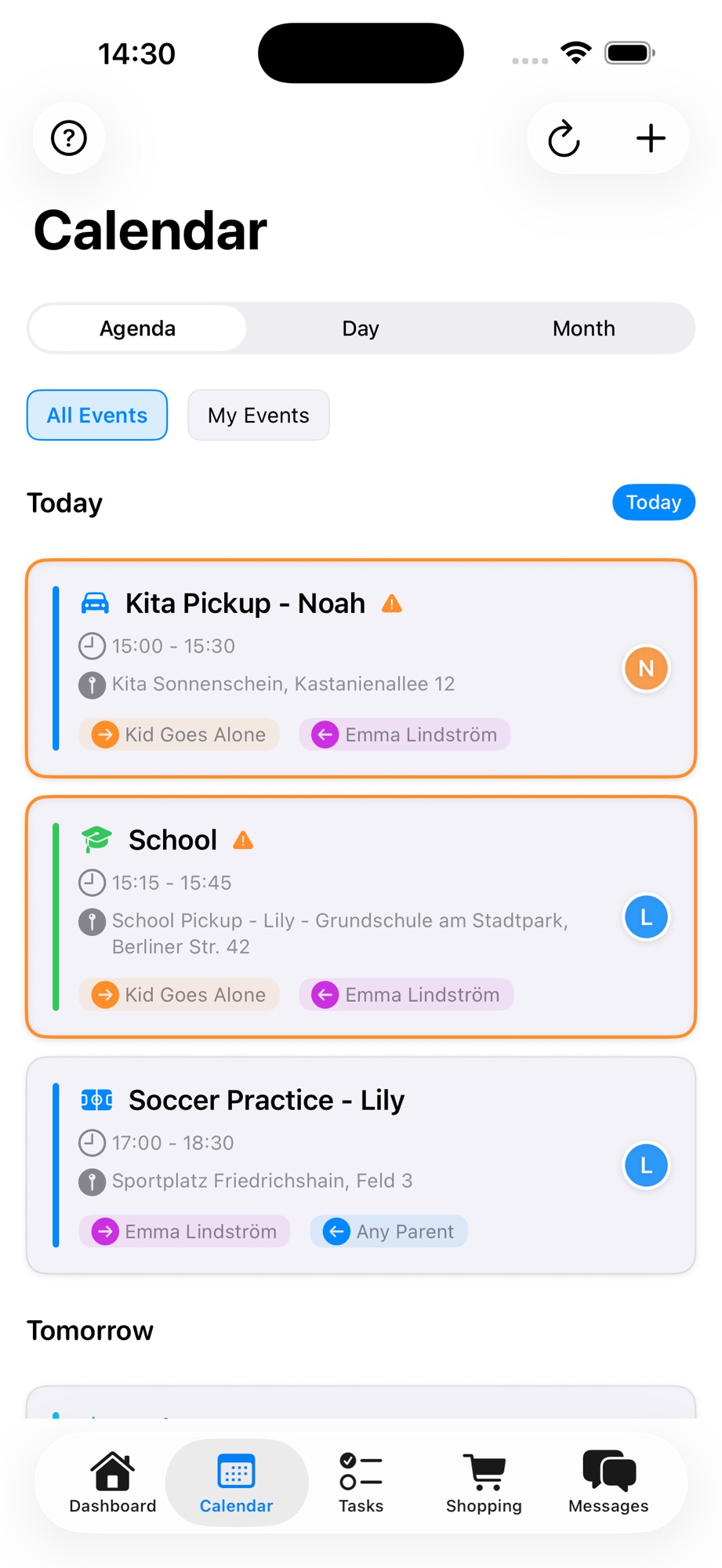
Pair that with a shared task list and the picture is complete: your au pair knows not just when they're on duty, but what the block is for — and you know the hours are being counted honestly on both sides.
The Compliance Checklist
Everything above, in one scannable pass you can run against your own schedule:
The hard limits:
- No single day exceeds
10 hoursof childcare - The full week stays at or under
45 hours(or30for EduCare) - At least
1.5 days offevery week - At least
1 complete weekend offevery month 2 weeksof paid vacation across the year
The counting:
- Naps, driving, waiting at activities, and on-call time all count
- "Quick favors" on days off count too — and are written down
- Coursework, sleep, and genuine free time do not count
- The actual finish time is logged, not the intended one
The safeguards:
- Days off are scheduled before the working hours are distributed
- The week is built with a small buffer under 45, not right at it
- Extra coverage comes from babysitting or backup care, never unpaid overtime
- Both sides can see the running weekly total in real time
The Numbers Are Really About Trust
It's tempting to treat all this as bureaucratic box-ticking — a set of federal figures to satisfy a coordinator on a check-in call. But the hour rules exist for the same reason a good schedule does: to protect the relationship at the center of the whole arrangement.
An au pair who is quietly worked to 47 hours a week doesn't file a complaint. They just get tired, then withdrawn, then — often around month six — they ask for a rematch, and nobody can quite say why the placement that started so well fell apart. Counting the hours honestly is how you prevent that slow erosion before it begins. It's not surveillance; it's the clearest possible signal that you see your au pair as a person with a life of their own, not an always-available pair of hands.
Get the counting right, and the rules stop feeling like a cage. They become the frame that lets everyone relax — because both sides know exactly where the lines are, and trust that they'll be honored.
Planning your au pair year? Download AuPairSync to track working hours in real time and keep every week safely under the 45-hour cap.