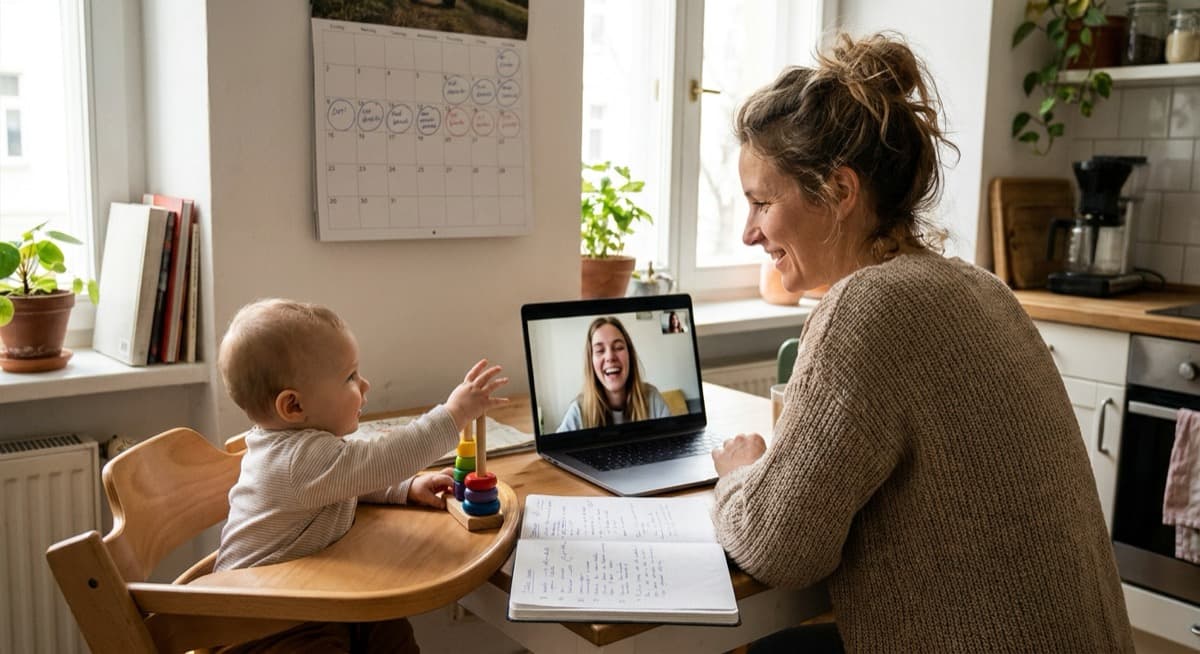
Hannah wrote "start date: 1 January" on her calendar in early October and felt organised. Her parental leave ended the first week of January, the nursery had a place for her son only from spring, and an au pair was the plan that filled the gap. She registered with an agency that week, finished her family profile on a Sunday and told her sister the hard part was done.
By mid-November she had held two video calls, one candidate had gone quiet, and the agency had asked whether her dates were flexible. Nobody had told her that matching is only the middle of the timeline. After the match come the visa, the paperwork and the flight, and each of those has its own clock. Her start date had been possible in October. By November it depended on everything going right.
This post is the timeline Hannah did not have. It covers the US programme (J-1, run through agencies) and Germany, and it is honest about one thing up front: nobody publishes a reliable average. Agencies give ranges, those ranges differ, and most come from the agencies' own pages. We attribute every number to its source below, and where we are only giving advice, we say so.
How this post differs from our interview guide: the matching guide is about how to interview and choose. This post is about how long the whole thing takes and how many calls to plan. Read this one first to set your dates, then that one to run the calls.

Schedules, tasks and costs with your au pair, in one app.

The short answer
For the US, the figures we could source are these. They come from agency pages, not from independent research, so treat them as what agencies tell families, not as guarantees.
| What | Figure | Source |
|---|---|---|
| Matching, after your application is approved | 2 to 12 weeks | AuPairCare (page written for au pairs) |
| Interviews before a family decides | "most families conduct one to three" | AuPairCare |
| From match to the au pair arriving (overseas) | "a minimum of six to eight weeks" | Au Pair USA |
| Au pair in a rematch | "typically must match within two weeks" | Au Pair USA |
Germany has no comparable published figure that we could find. The Federal Employment Agency says nothing about how long a search takes or how early to start. What it does say about the process matters for your calendar, and we cover it below.
Key takeaway: Plan from the date you want the au pair in your home, count backwards, and treat every range as a range. If your backwards count lands in the past, you are in last-minute territory, and that has its own section.
Why there is no single number
Two families with the same start date can have very different searches. Agencies name the same few reasons, and they are worth checking against your own situation.
AuPairCare says matching timelines "vary based on your profile, flexibility, and the time of year", and that "families search most actively in spring and summer for fall arrivals" (AuPairCare). That page is aimed at au pairs, so it describes the candidate pool's view, but the logic holds from your side: you compete with other families for the same people in the busy season.
What you can influence
- Flexibility on dates: AuPairCare notes that au pairs open to different start dates match faster. The same is plausible for families, though that page does not say so. A start window of two weeks is easier to fill than a single day.
- Your profile: a specific, honest profile draws better-fitting candidates. We wrote about this in how to write a host family profile that attracts matches.
- Your requirements: every must-have (driving licence, infant experience, a certain language) shrinks the pool. Keep the list short and real.
- How fast you answer: a candidate who waits a week for your reply may be talking to another family by then. This is our advice, not a sourced figure.
What you cannot influence
- The season. Spring and summer are the busy search months for autumn arrivals, according to the page above.
- Visa processing. In the US the au pair needs a J-1 visa and training before departing (Au Pair USA). In Germany it depends on the mission and the immigration office.
- The candidate's own notice period. Many au pairs finish school, a job or a degree before they can leave.
How many video calls to plan
The only sourced number is an agency's: AuPairCare says "most families conduct one to three interviews before deciding", and that "it is normal to interview with more than one family" from the au pair's side. So both sides are comparing.
The rule behind it is simple. In the US, the regulation requires the host family to have interviewed the au pair by telephone before departure (22 CFR § 62.31(e)). That is the legal floor: one conversation. Nothing in it says one call is enough to know whether you fit.
A plan that fits most households
This is our suggestion, not a requirement and not an average. It matches the structure in our interview guide.
- Call one (30 to 45 minutes): get to know each other. Talk about the children, the daily rhythm and why this person wants to be an au pair.
- Call two (45 to 60 minutes): go into the specifics. Walk through a normal weekday, the hours, the house rules, and one situation you worry about.
- A short reference conversation: with a previous family or employer, if the candidate has one.
- Call three, only if needed: a casual call with the children present, or a follow-up on one open question.
Two candidates at the second-call stage is a healthier position than one. If you only have one, you are not choosing, you are hoping.
Key takeaway: Count calls by decisions, not by number. You are done when both sides have seen the weekday, the hours, the house and the children's needs, and neither side is still guessing.
A realistic timeline, step by step
Here is the sequence, with the sourced ranges where we have them. The sum at the end adds figures from two different agencies, so it is a rough guide to the order of magnitude, not a promise.
United States 🇺🇸
🇺🇸 This section covers the US J-1 au pair programme. In the US the sponsor, an agency designated under the State Department's rules, must secure the host family placement before the au pair departs (22 CFR § 62.31(e)), so its own timelines apply.
- Application and approval: you complete your profile and background checks with the agency. The sources we found do not give a duration for this step.
- Matching: 2 to 12 weeks after approval, according to AuPairCare.
- Match to arrival: a minimum of six to eight weeks for an overseas au pair, according to Au Pair USA, covering the J-1 visa, training and travel.
- Arrival: the au pair arrives and starts. The regulation requires the agency's local counselor to meet the au pair in person within two weeks of arrival (22 CFR § 62.31(i)).
Adding the two ranges gives roughly 8 to 20 weeks from approved application to an au pair in your home. If you are reading this and your start date is closer than that, jump to the last-minute section. Also keep an eye on immigration rules for the au pair's stay. We track the current situation in our post on the J-1 duration-of-status rule.
Germany 🇩🇪
🇩🇪 This section covers Germany. Germany does not run the US-style sponsor system, and the details below come from German government sources.
The Federal Employment Agency recommends contacting a placement agency ("am besten kontaktierst du eine Vermittlungsagentur") and says agencies vet both applicants and host families (Federal Employment Agency). Many families still search on their own through platforms. Either way, the order of steps afterwards is the same:
- Find and agree on a match: no official duration.
- Sign the au pair contract. It sets the start and end dates, at least six months and at most a year (BA information sheet).
- Visa or residence permit. Depends on the au pair's nationality. Citizens of Australia, Canada, Israel, Japan, New Zealand, South Korea, the United Kingdom and the United States can enter without a visa and apply at the immigration office after arrival (§ 41 AufenthV). Everyone else needs a national visa from the German mission before travelling.
- Travel and arrival.
For the visa step, the Federal Employment Agency advises applying as early as possible before the planned start, and appointment slots at some missions can be booked months ahead. Our German visa timeline walks through the order and the deadlines, including the age limit of 27 that must not be passed before the immigration office decides (BA information sheet).
Key takeaway: In Germany the match is often the fast part. The visa and appointment queue is the part your calendar cannot compress, so ask your candidate's nationality early.
When the start date is close
Say it is eight weeks out and you have no match. Some options are slower than they look, and a few are faster. All of what follows is limited to what the sources say plus our own advice, which we mark.
Rematch au pairs
Au Pair USA states that au pairs in a rematch "typically must match within two weeks" (Au Pair USA). That makes them the fastest route to a start date in the US, because they are already in the country. It also means they decide quickly, so be ready to hold a call within a day or two. If you want to understand what such an au pair has been through, read our rematch guide.
Au pairs extending in the US
The same source says that when you match with an au pair who is extending, "you may need to wait six weeks or more" for the start, depending on when the extension begins. Not faster by default, but sometimes sooner than an overseas arrival.
Widen your window, not your standards
- Offer a start range instead of one date.
- Cut the must-haves that are preferences. Keep safety-related ones, such as the infant requirements in the next section.
- Arrange a bridge. A grandparent, a babysitter or a few weeks of daycare buys the time that no matching shortcut can. (Our advice, not sourced.)
- Do not skip the calls. A rushed match tends to cost more weeks than a late start, because a failed match means starting the search again with the baby already at home.
Matching for infant care
If your child is under two, the rules are stricter in the US, and they change who you can pick.
The regulation in 22 CFR § 62.31 says:
- Under two years old: the au pair needs at least 200 hours of documented infant child care experience (paragraph (e)).
- Under three months old: a parent or other responsible adult has to be present in the home (paragraph (e)).
- Training: before placement, au pairs receive at least eight hours of child safety instruction, of which at least four are infant-related and at least four are specific to children under two (paragraph (g)).
In practice, ask each candidate for the documented hours and what they covered: nights, feeding, a baby of what age, with whom. A candidate with 200 hours looking after one calm baby is not the same as 200 hours across several. Then ask what she would do if the baby would not stop crying at 3 a.m. and you were not home. The interview guide has the situational question approach.
For Germany we did not find a comparable mandatory hours rule in the Federal Employment Agency's material. Ask your agency what it checks, and set your own bar: references from babysitting or childcare jobs with babies, in writing.
Key takeaway: Infant care narrows your pool, so start earlier than the rest of this post suggests, and interview for the baby's actual routine, not for general love of children.
Questions to ask your agency before you start
An agency's range is only useful if you know what it measures. Ask these before you pay or register, and write the answers down.
- When does the clock start? At registration, at approval of your application, or at your first profile view? AuPairCare's "2 to 12 weeks" starts at approval.
- How many candidates will I see, and how fast? A shortlist in days is different from access to a searchable pool.
- Who arranges the interviews? Some agencies schedule calls for you; on other routes you reach out yourself.
- What happens if the match falls through before arrival? Ask whether you go back to the start of the search or keep your place.
- What is the fastest start date you have placed recently, and for which kind of family? A concrete example is worth more than a brochure range.
Your countdown checklist
- 16 to 20 weeks before: register, finish your profile, decide your must-haves and your flexible points. (The upper end is our rough sum above.)
- 12 to 16 weeks before: first video calls. Aim for at least two candidates at the second-call stage.
- 8 to 12 weeks before: decide, sign the match or the contract, and ask about the visa path at once.
- Until arrival: prepare the room, share the house rules and the schedule. Our arrival preparation guide covers it.
Once you match, the real work of the year starts. A written agreement, shared schedule and documents that both sides can see keep the first weeks calm; this is where a tool like AuPairSync helps, because the contract, the weekly plan and the emergency contacts live in one place for both of you. For the full picture of what comes after, see the au pair year by month and the cost breakdown.
Regulations change. The information in this article reflects rules and agency statements as of the publish date. Always verify current requirements with your placement agency or immigration authority.
The bigger picture
Hannah's start date did move, by three weeks. What saved the year was not a faster match but a better one: she took the third candidate, the one who asked about the baby's night routine before she asked about the salary. The bridge was her mother-in-law and a lot of coffee.
Matching feels like a wait you have to endure, but it is the one stage of the year where you can still change everything. Give it the weeks it needs, and the months after will be easier.
Planning your au pair's arrival? Download AuPairSync to keep your contract, schedule and family information organized from day one.