Hannah's first morning with her new au pair went better than she had feared. Nina arrived in the kitchen at 6:45, made breakfast without being asked, and the boys were dressed by 7:20. Hannah left for work feeling quietly relieved.
The phone call came at 8:40. Max, aged six, had gone to school without his swimming bag, which on Tuesdays is the entire point of the day. Nina had no idea. Nobody had told her Tuesday was different, that the bag lived in the cupboard under the stairs, or that Max would not mention it because he assumed adults knew.
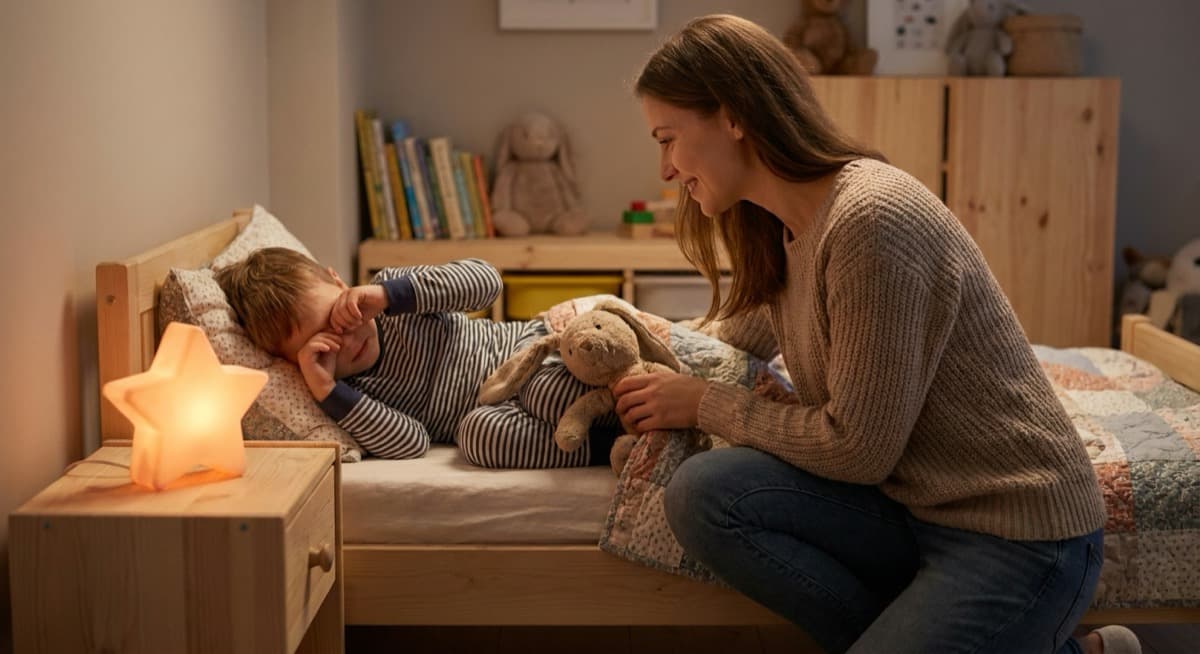
The bedtime that evening was worse. Theo, four, would not settle without the door open a hand's width, the lamp on and the rabbit tucked on the left. Nina read two books where the family reads one, turned the main light off too early, and spent forty minutes going up and down the stairs. Hannah had given her a schedule: on duty from 6:30 to 8:30 and from 14:30 to 20:30. She had never given her the routine.

Schedules, tasks and costs with your au pair, in one app.

A schedule is not a routine
You may already have the schedule right. It sets the weekly hours, the days off and the shape of the week, and that is where the job starts. This post is about the layer inside it: what actually happens at 7:00 and at 19:30, and how to hand that over so it does not live only in your head.
The two are easy to confuse because they sound alike. They answer different questions.
| Schedule | Routine | |
|---|---|---|
| Answers | When is the au pair on duty? | What happens, in what order? |
| Lives in | Calendar, written agreement | A short list per time of day |
| Typical gap | Hours that do not add up | The swimming bag, the lamp, the second book |
| Who notices a gap | You, at the end of the month | A tired child, at 19:30 |
Key takeaway: A schedule tells your au pair when to be there. A routine tells them what "doing it right" looks like for your children. Most handover problems in the first month are routine problems that were mistaken for attitude problems.
Why routines do the heavy lifting
Children rely on sameness more than adults do. The same sequence every evening tells a small child what comes next, and that is calming in itself, long before sleep arrives. When the sequence changes without warning, the child does not conclude that the new person does it differently. The child concludes that something is wrong, and protests accordingly.
That is also why it pays to be exact. "Do the usual bedtime" is a sentence that only makes sense to someone who has lived through a hundred bedtimes. For a third caregiver in the house, whether a new au pair, a babysitter or a grandparent, the usual has to become a list.
There is a second benefit that parents tend to notice later. A written routine takes the argument out of the evening. If the list says bath, pyjamas, two teeth-brushing rounds, one book, lamp, door, then your au pair is following the family's plan and not enforcing a personal opinion. Your children can tell the difference, and so can your au pair.
Start with a morning walkthrough
Before you write anything down, watch your own mornings for three days. Do not fix them, just note them. Most families discover that the "routine" they thought they had is really four or five fixed points and a lot of improvisation between them.
The fixed points in a typical morning
Write down only what has to happen, and when it has to happen by:
- Wake-up: the time, and how (open the curtains, a song, a gentle shoulder).
- Breakfast: what is allowed, what is not, who sits where.
- Getting dressed: who chooses, what is already laid out the night before.
- Bags: which bag for which day (swimming, music, gym kit, library book).
- Out of the door: the time you leave, the route, who holds whose hand.
- Drop-off: where, who says goodbye how, what to do if a child clings.
The bag line is the one most families forget, because the parent does it on autopilot. Put the weekly differences in a small table and stick it where the school bags live:
| Day | Extra for the bag | Pick-up |
|---|---|---|
| Monday | Library book | 15:30 |
| Tuesday | Swimming bag | 15:30 |
| Wednesday | Music folder | 13:00 |
| Thursday | Nothing extra | 15:30 |
| Friday | Gym kit | 15:30 |
What your au pair will not guess
Some things cannot be inferred by a sensible adult who has just arrived:
- The child who refuses to put on socks and needs to be handed them last.
- The sibling pair that cannot sit next to each other at breakfast.
- The medicine or the vitamin that comes with breakfast on certain days. If there is a medical detail, put it in writing in the child profile and not in a chat message that scrolls away.
- What counts as "ready" when time runs short: shoes on counts, hair brushed can wait.
The last item is the most useful one. A routine needs a version for the day everything goes wrong. Decide in advance what gets dropped when you are ten minutes late, and your au pair does not have to make that call at 7:50 with two children in tears.
Key takeaway: Write the morning as an ordered list, add the weekly exceptions in a table, and name the one thing that can be skipped when time runs out.
Then the bedtime
Bedtime is where children are most sensitive to change and adults are most tired. It is also the routine where the small details carry the most weight.
The order matters more than the clock
A bedtime routine is a chain. A common shape is dinner, bath or wash, pyjamas, teeth, a book or a story, lights down, a last goodnight. Families vary enormously, and none of that variation is wrong. What matters is that the chain is the same each evening and that your au pair knows the sequence.
Write down the steps and the time boundaries that really matter. "Lights out around 19:45" is a guide. "Screens off after dinner" is a rule. Your au pair should know which is which. If screens are part of your evenings, the screen-time rules post shows how to turn them into something your au pair can enforce without a debate.
The small things only you know
This is the part that fails when it is only spoken. The star lamp, the rabbit on the left, the song, the exact width of the open door, the glass of water that must be a particular cup. Parents do these things so naturally that they stop seeing them as a routine at all.
Collect them in one place per child:
- Comfort items: which toy, which blanket, where they live during the day.
- Light and sound: lamp on or off, door open how far, white noise or silence.
- Words: the song, the phrase, the goodnight order if there are siblings.
- What to do if they get up: walk them back calmly, no new snack, no screen, same words.
- When to call you: a fever, a nightmare that does not settle, anything that worries your au pair.
For a child this is exactly the information that makes a stranger feel safe. It is also what the children in an au pair changeover miss most when the new person does it differently, which is why the advice there is to keep the routine identical across the handover.
What changes with age
A single routine does not fit three children at three ages. Rather than writing one long list, write a short common spine and a small per-child note. Our post on looking after children of different ages covers how to stagger bath times and bedtimes, and the same logic applies here: the oldest keeps the later slot, the youngest goes first, and the au pair knows who needs the most attention at which moment.
Teach it in the first week, not the first month
The best moment to hand over a routine is the first week, while your au pair is still watching everything closely and has no habits of their own to unlearn. The first week survival guide gives the wider picture; here is how it works for routines specifically.
- Days 1 to 2: you lead. Run the morning and the evening yourself and let your au pair watch. Say the reasons out loud as you go ("he gets the socks last because otherwise there is a fight").
- Days 3 to 4: you work side by side. Your au pair does the steps, you stay in the room and only step in for safety or for something that really matters to the child.
- Days 5 to 7: your au pair leads, you stay in the house. Be reachable and visibly relaxed. Children notice if you hover.
- Week two: your au pair runs it alone. Check in the evening, not in the middle of the routine.
Resist the urge to correct small things in front of the children. A child who sees the parent overrule the au pair at 19:30 learns that the au pair does not have the final word, and bedtimes get longer for weeks. Note the point, mention it in the weekly talk, and keep the evening calm. The weekly check-in is the right place for the "next time, could you" conversation.
Write it down once, keep it where people look
A routine that lives in a long message thread is a routine nobody can find. The format matters less than the habit of keeping one version, in a place both of you open every day.
A good routine page is short. One screen per time of day, with the steps numbered, the weekly exceptions beneath and the per-child details at the bottom. Avoid prose; nobody reads a paragraph at 7:40.
If you use AuPairSync, the ordered steps can live as recurring tasks so the morning and the bedtime appear on the au pair's day without anyone typing them again, and the per-child details (the lamp, the song, the nap window) sit in the child profiles. That is one good way to do it. A laminated sheet on the fridge works just as well if you actually keep it up to date.
Whatever you choose, test it once: ask a friend or a grandparent to run bedtime from your page alone. Wherever they get stuck is a gap in the routine, and it is cheaper to find that on a quiet Saturday than at 19:50 on a Wednesday.
When a routine does not work
Even a well-written routine runs into trouble in the first weeks. Most of it falls into three patterns, and each has a calm answer.
The children push back
A new caregiver gets tested. A child who sleeps through the night for you may suddenly need three glasses of water for your au pair. This is not a sign that the routine is wrong or that your au pair is doing it badly. Children check whether the rules still hold when the person changes. The answer that helps is boring: the same steps, the same words, the same calm voice, every evening, for a few weeks. If your au pair gives in on night two, the child learns that night two is where the rules end.
Tell your au pair this before it happens. A caregiver who expects the test takes it less personally, and a caregiver who has been told "this is normal, hold the line" is far more likely to hold it.
The routine is too long
Some written routines grow until nobody can follow them. If your bedtime list has fourteen steps, your au pair will skip some of them, and the child will notice which ones. Cut it down to the steps that actually matter to the child and keep the rest as a preference, not a rule. Ask yourself of each line: if this were missing, would the child notice, or only I?
Things change in the middle
Illness, a holiday, a school trip or a new sibling all break a routine for a while. Write down the one-line version for these days too ("when a child is ill: bed early, no bath, medicine at 19:00, call me if the fever rises"). A routine that only works on ordinary days is a routine that fails exactly when your au pair most needs it.
Weekends and school holidays
Many families keep the routine on weekdays and let it blur at weekends. That is fine, as long as everyone knows which version is in force. Mark the differences ("Saturday: breakfast at 8:30, no bags, no rush") so that your au pair is not guessing whether Saturday follows the Monday rules. During school holidays the mornings loosen, but the bedtime chain is usually worth keeping the same, because it is the part children rely on most.
When the routine is also the plan B
A written routine earns its keep on the days you are not there. When you are away for a weekend, a good overnight plan is mostly the routine plus the contacts and the rules for emergencies. When your au pair is ill and a babysitter steps in, the page becomes the briefing. When you hand over to the next au pair at the end of the year, it is the most valuable document you leave behind.
That is also why it is worth reading the page again every few months. Children outgrow routines. The second book becomes a chapter, the lamp gets switched off, the swimming bag moves to Thursday. Update the list when the evening changes, not when it has already broken.
A one-page checklist
- Morning steps in order, with the time you must leave.
- Weekly exceptions in a table (bags, pick-up times, activities).
- A named "if we are late" shortcut.
- Bedtime steps in order, with the rules that are fixed and the times that are only a guide.
- Per-child details: comfort items, light, door, song, medicine.
- What to do when a child gets up again.
- When to call you, and how.
- A date when you will read it again.
The bigger picture
Parents sometimes worry that writing a routine down makes the house feel like an office. It tends to do the opposite. When the steps are clear, your au pair stops guessing and starts paying attention to the child in front of them, which is what you wanted in the first place. Children feel the difference: the same hands, the same song, the same words every evening, no matter who is doing it.
A year with an au pair is a long time to share your children's most tender hours with someone. Give them the page that makes it easy to get them right.
Frequently asked questions
What is the difference between an au pair schedule and a daily routine?
The schedule says when your au pair is on duty. The routine says what happens inside those hours: the order of the morning, who packs which bag, what the last twenty minutes before sleep look like. A schedule can be perfect and the evening can still go wrong.
How do I teach my au pair our morning routine?
Run it together once or twice, then write it as a short ordered list with one line of detail per child. In week one stay in the house but let your au pair lead, and fix only what matters for safety or for the child's comfort.
What should a bedtime routine document include?
The order of the steps, the small things only you know (which toy, which song, how far the door stays open, which light), and what to do when the child gets up again. Keep it to one page per child.
What if the children behave differently for my au pair than for me?
That is normal. Children test a new caregiver. Keep the order and the wording the same for a few weeks and the difference usually shrinks. If it does not, talk about it in the weekly check-in rather than in the middle of bedtime.
Should I write the routine down or just tell my au pair?
Write it down. Spoken instructions are reliable for the first three days and then drift. A written routine also lets a babysitter, a grandparent or the next au pair run the same evening.
Setting up your mornings and bedtimes? Download AuPairSync to keep the steps and each child's small details in one place your au pair can open from day one.