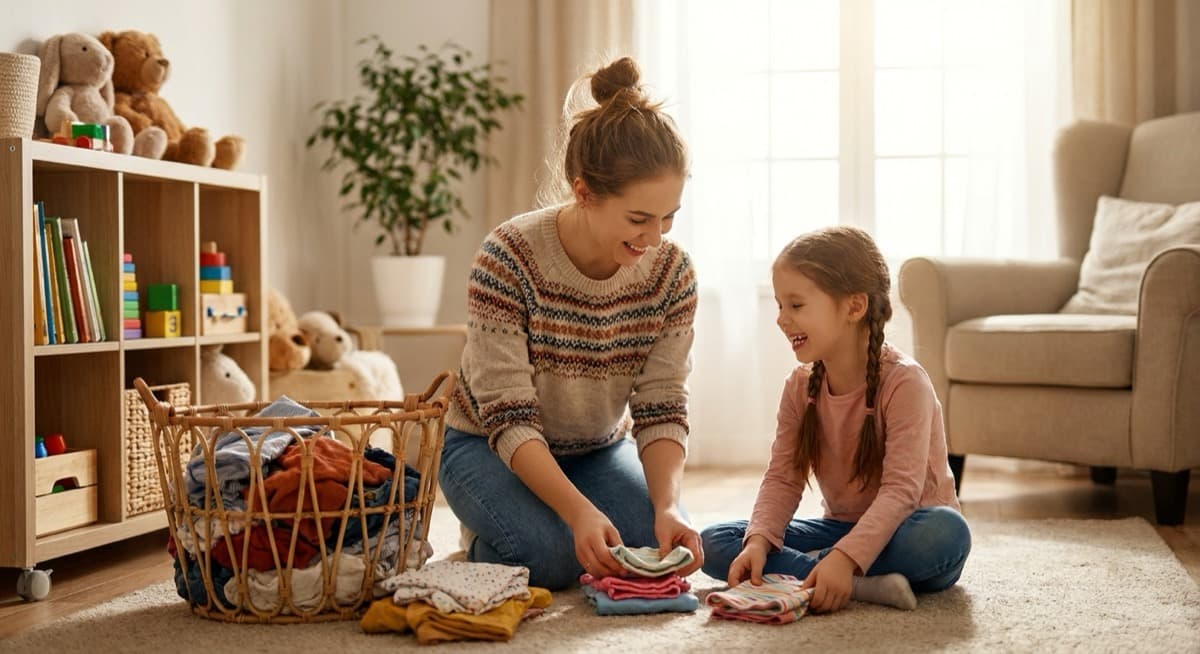
Rachel thought she had been generous. Her au pair, Camila, was twenty-two, tidy and cheerful, and in week two she had said "no problem" to everything. The kids' laundry, sure. The kitchen floor, sure. The family's bed linen on Saturdays, the bathrooms on Sundays, a quick vacuum of the living room before the in-laws came. Rachel never wrote any of it down. It just seemed like what a helpful person in the house would do.
By week eight Camila had stopped smiling at breakfast. When Rachel finally asked what was wrong, Camila said, very politely, that her coordinator had told her the job was childcare and light housework for the children. She had been cleaning for a whole household for two months and did not know whether she was allowed to say no.
Nobody had acted in bad faith. Rachel had never decided where "the children's chores" end and "the house's chores" begin. Neither had Camila. That line is exactly what this guide is about, and it is much easier to draw on day one than in week eight.
🇺🇸 This guide covers the US J-1 au pair program. The duties, hour limits and wording below come from the State Department's rules. Other countries run au pair programs differently, so check your own country's rules if you host elsewhere.

Schedules, tasks and costs with your au pair, in one app.

The rule in one sentence
An au pair on the J-1 program is there for childcare and light housework that relates to the children. That is the whole rule. The program is built around cultural exchange and care for your kids, not around running the household.
The hours that the State Department sets in 22 CFR 62.31 apply to all of this. Child-related chores are part of the working week, not something extra on top of it. Your sponsor's handbook explains how your agency applies the rules, and it is the document to check for your exact placement.
The words "child-related" do the heavy lifting here. A task qualifies when it exists because of the children and would mostly disappear if they did. A task does not qualify just because the au pair happens to be standing near it.
A quick test for any chore
Before you add something to the list, ask three questions:
- Would this chore exist without the children? The kids' laundry would not. The parents' shirts would.
- Whose mess is it? A snack plate left by a six-year-old is child-related. A week of dishes from a dinner party is not.
- Is it light? Folding, wiping, putting away and tidying are light. Scrubbing grout, cleaning ovens and deep-cleaning bathrooms are not.
If the answer to the first question is "no", stop. The other two questions only matter once the first one is a yes.
What counts as child-related housework
This is the part families rarely get wrong, but it helps to see it written out. The following sit comfortably inside the rule.
| Usually fine | Why it counts |
|---|---|
| Washing, drying and folding the children's laundry | The laundry only exists because of the children |
| Making the children's beds and changing their sheets | Tied to their rooms |
| Tidying the children's bedrooms and the playroom | Their space, their mess |
| Preparing the children's breakfast, lunch or snack | Feeding the kids is childcare |
| Loading the dishwasher after the children's meals | Cleanup of their meal |
| Wiping the table and floor after the children eat | Same, and it goes with the meal |
| Packing school bags and lunch boxes | Directly part of the school routine |
| Keeping toys, books and school things in order | Child-related organisation |
None of these is a favour. They are the ordinary shape of a day with children, and a good au pair expects them.
Key takeaway: If you can finish the sentence "I am doing this because of the children", it is probably child-related. If you have to add "and also the rest of us", it is not.
Where the children's things end
The children's laundry is clear. The towels everyone uses are less so. A reasonable way to handle it is to separate the loads at the source: the children's clothes and bedding go into the au pair's load, and the shared towels and the adults' clothes stay with the family. A basket for each helps more than any rule.
The same applies to dishes. The au pair clears and loads what the children used. Dinner for the adults, and the pots after it, stay with the adults.
What crosses the line
This is where most friction starts. These tasks are general housework, and they are outside what the au pair is there to do.
| Not child-related | Why it falls outside |
|---|---|
| Vacuuming or mopping the whole house | Household cleaning, not the children's space |
| Scrubbing bathrooms | Heavy cleaning for everyone |
| The parents' laundry and ironing | Adults' clothes |
| Cooking dinner for the whole family | Beyond the children's meals |
| Cleaning the oven, windows or fridge | Heavy household cleaning |
| Yard work, snow shovelling, gardening | Not related to the children |
| Deep cleaning before guests arrive | A household task |
| Grocery shopping for the family | Household errand, not childcare |
You will notice that some of these feel small. Vacuuming for ten minutes is hardly an event. The problem is not the size of any one task. It is the direction. Once the list is allowed to drift from the children toward the house, there is no obvious stopping point, and the au pair becomes the family's domestic help in all but name.
The question of pay
Some families say, "But we pay her stipend, and she lives with us." That is true, and it does not change the rule. The weekly stipend is the au pair's pay for the childcare program. It does not buy a cleaner. If you need the house cleaned, a cleaning service is the clean solution, and many host families find it is worth a few hours a month to keep the peace.
The grey areas, one by one
The two lists above cover most days. The trouble comes from tasks that sit in between. Here are the ones host families ask about most.
"While you're up"
The most common blur. The au pair is already in the kitchen to clear the children's snack, and the parent says, "Could you wipe the counters while you're there?" The counters are not wrong to wipe. They are just not the children's chore.
One wipe of the counter after a snack she just served is part of tidying up the snack. A standing request to leave the kitchen spotless every afternoon is a household duty. The difference is whether the task follows from the children or from the room.
If you notice yourself saying "while you're up" more than twice a week, write the task down and decide whether it belongs on the list at all.
Shared spaces
Kitchens, living rooms and bathrooms are used by everyone. Nobody owns the mess. A helpful rule of thumb: the au pair is responsible for her own room, the children's rooms and the play areas, and for the cleanup that follows what the children have just done. Everyone cleans up after themselves in the shared rooms.
Her own bedroom and bathroom, if she has one, are hers to keep tidy. That is part of living in a household, not part of her duties.
Cooking
Making the children's lunch is child-related. Making a family dinner is not, even when the au pair enjoys it. If she cooks for the children and the adults happen to eat the same meal, that is not a problem. The test is why the meal exists, not who ends up eating it. Our post on meal planning and cooking with an au pair goes into this in more depth, and the same logic applies there.
Pets
The family dog is not a child. Walking it may be a lovely thing for an au pair to do, but it is not the same as the children's chores, and it should be a clear, voluntary agreement and not something that appears on the list by habit. Whatever you decide, say it out loud and write it down, and leave room for a no.
Sick days and busy weeks
A flu week is not the time to hand over the whole house. If a parent is ill or travelling and the family needs help, ask for it as a favour, offer something back, and keep it short. Time-limited help with a clear end is very different from a new standing duty.
Visitors and special occasions
Grandparents arriving on Friday does not make the whole house a child-related space. Tidying the children's rooms before they stay over is fine. Preparing the guest room, cooking the welcome dinner and cleaning every surface is a household project, and it belongs to the adults or to a cleaner hired for the day. The same goes for birthday parties: the au pair can help with the children's side of it, but the party itself is yours to host.
Chores are hours too
A point that surprises many families is that chores use up the working week. If an au pair spends forty minutes a day on laundry, tidying and meal cleanup, that is nearly five hours a week before she has looked after the children for a single minute.
That is why a list can feel light task by task and still be too much when you add it up. The hours and days off guide shows how to count time properly. A simple habit helps: next to each recurring chore, write how long it really takes. If the total surprises you, change the list before the au pair has to say anything.
How to write the chore list
A chore list does not need to be long. It needs to be specific, and it needs to be written. Most disputes come from tasks that were agreed in the kitchen and remembered differently by each side.
Keep it to the children
Start with the children's routine: breakfast, school bag, laundry, bedroom, playroom, snack, dishwasher after their meals. Put each task under the part of the day where it belongs. A list tied to the routine is easier to remember than one sorted by room.
Say what done looks like
"Tidy the playroom" can mean putting the toys in the baskets or sorting every Lego brick by colour. Agree what is enough. A quick description or a photo of the finished room helps; the family task list for au pairs looks at four things to include with each task.
Write down what is not on the list
This feels odd and works well. A short "not part of the au pair's duties" line, with things like cleaning bathrooms, the parents' laundry and cooking for the whole family, saves both sides from guessing. Say it kindly and say it early.
A wording that works:
"Camila helps with the children and their things: their laundry, their rooms, the playroom and the cleanup after their meals. The rest of the house is ours. If something comes up that is not on this list, we will ask, not assume, and it is fine to say no."
Review it after four weeks
A list is a first draft. After a month, sit down for fifteen minutes and ask what is working, what is taking longer than expected, and what is missing. Changes after that should be small and agreed, not slipped in.
If you are building a bigger set of expectations, the family handbook guide and the guide on writing an au pair agreement show where the chore list fits.
When the line has already blurred
Maybe you read the first half of this post and recognised your own kitchen. That is common, and it is fixable without a drama.
- Admit it first. Start with your own part: "I have been asking for more than I should, and I want to put that right."
- List what has been happening. Write down what the au pair actually does each week, in her words as well as yours.
- Sort it into two columns. One for child-related, one for household. Be honest about the second column.
- Decide what leaves. Hire a cleaner, split the chores among the adults or drop the task.
- Agree on the new list in writing. Short, specific, shared.
If you are not sure how to open the conversation, the house rules guide has wording for resetting expectations without making it feel like a complaint. And if the problem keeps coming back, your local childcare consultant is the person to ask. That is what the role is for.
Signs she is carrying too much
An au pair who does not want to complain will rarely say it directly. Watch for quiet signals:
- She stops volunteering for small extras that she used to enjoy
- She spends more of her free time in her room
- Tasks are done more slowly, or with less warmth
- She mentions what other au pairs in her group are doing, in a careful tone
- She checks the clock more than she used to
None of these is proof. Each is a good reason to ask a gentle question at the next weekly check-in.
Keeping the list visible
A list that lives only in a conversation will drift. Putting the child-related chores somewhere both sides can see helps keep it honest, and a shared task list does the job. Visual task management in AuPairSync lets you attach a photo to a task, so "tidy the playroom" comes with a picture of what finished looks like, and the recurring chores on the au pair's plate stay clear and documented instead of renegotiated each week.
The bigger picture
The child-related rule is not only a technicality. It protects the thing that makes the arrangement worth having: an au pair who is part of your family's daily life with your children, not an employee of your household.
Host families who respect the line tend to get more from it. The au pair has the energy to be present with the kids, to learn from the exchange and to come back from a day off glad to be there. The family gets a person who is invested, not one who is quietly keeping count.
Rachel and Camila sorted it out in an evening. They wrote the list, Rachel booked a cleaner every second week, and Camila went back to her bad jokes at breakfast. It cost very little and it saved the year.
Frequently asked questions
What housework can a J-1 au pair do?
Light housework that relates to the children: their laundry, tidying their bedrooms and play areas, loading the dishwasher after their meals and preparing their food. Cleaning the whole house, the adults' laundry and heavy work such as scrubbing bathrooms are outside the child-related scope.
Can I ask my au pair to clean the whole house?
No. Under the State Department's au pair rules the duties are child-related. General housekeeping for the household is the family's job, or a cleaner's, and it should not be added to the au pair's list.
Does housework count towards my au pair's hours?
Yes. Child-related housework is part of the au pair's duties, so it counts towards the weekly and daily hour limits in 22 CFR 62.31. Ten minutes here and there adds up across a week.
Can my au pair cook for the whole family?
Cooking for the children is child-related. Cooking dinner for the whole family is generally outside the scope. If the au pair makes the children's meal and the adults eat the same pot, that is fine; the test is whether the task exists because of the children.
What if my au pair offers to do extra chores?
A one-off kindness is a gift, not a duty. Say thank you and do not let it turn into a standing task. If it happens every week, it has become a request, and it belongs inside the rules.
Setting up your au pair's tasks? Download AuPairSync to keep the child-related chores clear and documented from day one.