Beth works late on October 31. She had texted her au pair, Joana, a plan at lunchtime: costumes are in the hall closet, trick-or-treating starts around 5:30, be back by 7:30. Joana, twenty-two and from a small town in northern Portugal, had been in the house since August. She said yes, of course.
At 5:30 she walked her six-year-old and nine-year-old down the street. At the first house with a dark porch, the nine-year-old went to ring the bell. Joana pulled him back, sure it was rude. At the next house, a neighbor handed each child a fistful of candy, and Joana did not know whether to thank her, pay her, or check what was in it. By the third block the six-year-old was crying about a wet costume. Nobody had told Joana what the evening was supposed to look like.
Nothing went wrong in the end. But Beth, hearing the story at 8:00, saw what she had skipped. She had planned the evening around a tradition she has known since she was small, and she had handed it to someone who had never done it. This guide is the briefing she wishes she had given: what to tell your au pair about fall and Halloween, which activities fill the season's afternoons, and how to turn all of it into a real cultural exchange.
🌍 This guide uses the US as its main example, with notes for Germany. Halloween customs, school events and neighborhood rules differ by region and by street, so check your own. Where the au pair's working hours come into it, the rules of your program apply.

Schedules, tasks and costs with your au pair, in one app.

Why Fall Is Good for Cultural Exchange
Fall gives you a run of events that are visual, physical and easy to join without perfect English. Nobody needs a long conversation to carve a pumpkin or rake a leaf pile. For an au pair in her first autumn abroad, that makes it one of the easiest seasons to feel part of the family rather than a helper in the house.
It is also a ready-made source of afternoon ideas. If you already run a loose list of cultural exchange activities, fall is the season where half of it writes itself.
What the Season Asks of You
Three things make fall go smoothly: a short briefing before the first event, a plan for who does what, and room for your au pair to bring her own traditions. The rest of this guide takes them in that order.
Brief Your Au Pair Before the Season Starts
Your au pair probably knows what a pumpkin is. She may not know what you expect when one shows up on a porch. The things that feel obvious to you are exactly the things nobody explained to her.
| Tradition | What happens | What she may not know |
|---|---|---|
| Pumpkin patch | Families pick a pumpkin from a field or lot, often with a hayride or a corn maze | Who pays, and whether she picks the pumpkin or the children do |
| Jack-o'-lanterns | A pumpkin is carved with a face and lit from inside | Adults handle the knife and the candle or light; children draw and scoop |
| Costumes | Children dress up for school parties and for the evening | Who buys, who sews, and what the school allows |
| Trick-or-treating | Children go door to door asking for candy | Which houses take part and how late children are out |
| School and daycare parties | Costume parades and treats at school | The sign-up sheets and the allergy rules attached to them |
Key takeaway: Ask yourself what you want from the evening, since "does she know Halloween?" will not tell you that. Write the answer down in a few lines before October 31.
The Five Lines to Write Down
- Where the children may go: which street, which blocks, which houses
- When they leave and when they return: one clear time each
- Who goes along: your au pair alone, you with her, or you meeting later
- What happens with the candy: where it goes when they get home and who decides how much
- Your phone number and the plan if a child is scared or tired: it is allowed to go home early
Fall Activities That Work With Kids
You do not need a full program. Pick two or three from this list and make them regular, because the children will ask for them again.
Pumpkin Patch and Apple Orchard
A pumpkin patch or a pick-your-own orchard is an easy half day. It works for toddlers (with a stroller path) and for ten-year-olds (who want the corn maze). Agree beforehand who covers the entry fee and what she may spend on cider or doughnuts, so she is not guessing at the till. If the orchard is a drive away, say who has the car and the car seats, and who checks that a child's thick fall coat is off before the buckle goes on.
Leaf Walks and Nature Collecting
A leaf walk costs nothing. Give each child a paper bag and a list: three different leaf shapes, one acorn, something red. At home, press the leaves between heavy books, or glue them onto a card. Younger children enjoy the sorting. Older ones can name trees if you let your au pair teach them the names in her own language.
Pumpkin Carving, Done Safely
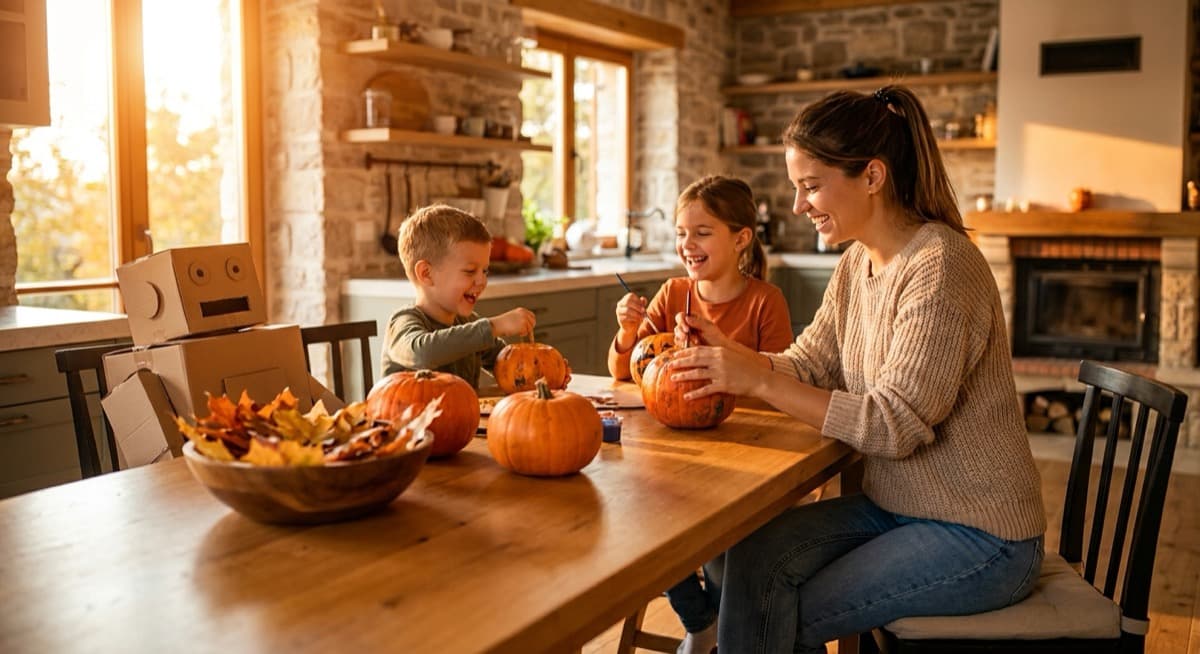
Carving is a two-job activity. The adult cuts and the children design. Draw the face on with a marker first, let the child scoop the seeds with a spoon, and keep the knife with the grown-up. Roast the seeds afterwards with a little oil and salt.
Baking and Cooking
Apple, pumpkin and cinnamon are the flavors of the season, and children like measuring and stirring. This is also where your au pair's own recipes fit in naturally, which we cover below. If cooking together is already part of your week, the meal planning and cooking guide shows how to keep that tidy.
Costume and Craft Afternoons
When the weather is bad, a craft afternoon is a good fallback. A costume workshop is the best version: put out cardboard, tape, old fabric and markers, and let the children pitch what they want to be. Your au pair will find out in ten minutes what the children actually care about, which is useful for the rest of the year.
Which Activity for Which Age
| Age | Good fit | Plan around |
|---|---|---|
| 2 to 4 | Leaf collecting, pumpkin painting, short orchard visit | Naps and a stroller path |
| 5 to 8 | Pumpkin carving design, costume making, corn maze | Short attention span and wet shoes |
| 9 to 12 | Baking, leaf-pile photos, planning a costume or a story | Wanting to do it alone with friends |
A Rainy-Day Plan
October weather is unreliable, so keep one indoor version of the season ready. A rainy Saturday can still be a baking afternoon, a costume workshop with cardboard and tape, or a pumpkin-painting session on the kitchen table. Painting skips the knife, which makes it the better choice for the youngest children. Agree where the supplies live, so your au pair does not have to ask where the tape is while a toddler waits.
What It Costs
Fall activities are cheap, but they are not free. Entry to a pumpkin patch, a pumpkin, cider and a bag of candy for your own doorstep add up across a month. Decide on a small fall budget and tell her what it covers. If she pays out of pocket, agree how she gets the money back. A photo of the receipt on the day is enough to keep the accounting simple.
More Than Halloween: Fall Events to Plan For
Halloween is the loudest date, but it is not the only one. School and daycare often run a fall festival, a costume parade, or a harvest party, and each usually comes with a sign-up sheet. Read them early. A parent who forgets the sheet usually gets a text on the morning of the event asking for twenty cupcakes, and that is a bad moment to hand the job to an au pair who has never baked for a school party.
Thanksgiving Is Next
In the US, Thanksgiving falls on the fourth Thursday of November, which is November 26 in 2026. It is a bigger family holiday than Halloween, and the questions start earlier than you would expect: is she invited to the family dinner, does she travel, and who cooks what? Raising it in October gives her time to plan, and gives her something to look forward to. For an au pair far from home, an explicit invitation matters.
Halloween Step by Step
Halloween is the one date in the season with real logistics. It deserves its own plan.
Costumes
Let the children choose, and let your au pair help make it. A costume built from a cardboard box and a few hours together is better exchange than anything bought. Three practical rules help:
- Comfort first: check that a child can walk, sit and use the toilet in it
- Visibility: reflective tape or a small flashlight, because it gets dark early
- Masks: many children cannot see well through one, so face paint or a hat is often better
It is worth trying the costume on a few days ahead. A cold evening in a thin costume is the most common reason a child wants to go home after twenty minutes. The winter safety guide explains how to layer under one.
Trick-or-Treating Rules to Share
Trick-or-treating is built on small local customs. In many neighborhoods a porch light on means the house is taking part, and a dark porch means it is not. Children say "trick or treat" at the door and "thank you" when they leave, and they take one or two pieces unless the bowl is offered.
Share these rules, in your own words:
- Only go to houses with the light on
- Stay on the sidewalk and cross at the corner
- Walk, do not run, between houses
- Stay together, and stay where the au pair can see every child
- Never go inside a house, and never get into a car
Candy and Allergies
Candy is where a calm evening can turn serious, because wrappers rarely list everything. Decide in advance that nothing gets eaten on the street, and that the au pair sorts the haul at home. If one of your children has a food allergy, the household rule is simple: unknown or unwrapped candy is thrown away. Our guide on putting allergies and medications in writing shows how to give your au pair a single sheet she can check.
When a Child Does Not Want to Go
Some children find Halloween frightening. A skeleton on a lawn is not funny to a four-year-old. Give your au pair permission to turn back, and tell the child that going home is fine. It teaches the child something too, and it takes pressure off her.
Hours, Pay and Halloween
An evening of trick-or-treating is work if she is responsible for the children. In the US program, that means it counts toward the 45-hour week and the 10-hour day, and our explanation of the 45-hour, 10-day rule shows how quickly a long fall week fills up with one evening event, a school party and a pumpkin-patch Saturday.
If you want her to join you as a guest, such as carving pumpkins as a family, say so. Time spent as a participant is different from time spent in charge. The cleanest approach is to agree before the event which one it is.
If you are in Germany, the same logic applies to your agreed daily and weekly limits.
Make It a Two-Way Exchange
Cultural exchange means both sides learn. If your au pair only receives American autumn and never shares her own, you have a pleasant season but a half exchange.
Ask What Her Autumn Looks Like
Ask her what happens at home in October and November. Some answers may surprise you. In parts of Portugal, children go from house to house on November 1 for small gifts of bread and sweets, a custom called Pão por Deus. In Mexico, Día de Muertos on November 1 and 2 is a family celebration of remembered relatives, with flowers and food, not a scary one. Your au pair may have a different tradition entirely.
You do not need to copy it. You can cook one dish together, learn one song, or put one photo on the fridge. Children remember this longer than most things.
Include the Hard Moments
The first autumn abroad can be lonely. Short days, family holidays at home that she misses, and a new place that has not become familiar yet can all land at once in November. If it shows up, the guide to homesickness and culture shock gives you language for it.
A Note for Families in Germany
Halloween is not a traditional German holiday, but it has become common, especially in cities. Children in some neighborhoods ring bells and ask for Süßes oder Saures, and not every household appreciates it. Ask your neighbors, or stick to friends and neighbors you know.
A more local tradition arrives on November 11: St. Martin's Day, when children walk with paper lanterns in a lantern procession, called a Laternenumzug, and often sing traditional songs. If your au pair is from the US, that may be the German tradition she remembers longest. Making a lantern together is an easy craft, and a good return gift for the Halloween she showed the children.
Putting the Season on One Page
Fall has more dates than you think: the school parade, the harvest fair, the pumpkin Saturday, the evening itself. Put them in one shared family calendar, so your au pair and both parents see the same plan, including who is picking up, who is on the street and when the family is home. If your children's after-school week is already full, the after-school pickups guide helps you fit the extra events in.
A Season Checklist
- Early October: pick your two or three fall activities and put them on the calendar
- A week before: talk through costumes, and decide who buys and who makes
- Two days before: try the costumes on, check the weather, and write the five lines
- Halloween afternoon: an early dinner, a charged phone and a flashlight
- Halloween evening: home by the agreed time, candy sorted at the kitchen table
- The week after: ask your au pair what she would do differently, and what she liked
Why It Matters
At the end of her year, your au pair will not remember the recipe for roasted pumpkin seeds. She will remember a child holding her hand on a dark street, a family laughing at a lopsided jack-o'-lantern, and a neighbor who knew her name. The cultural exchange part of an au pair year is built from small evenings like these, and October gives you more of them than any other month.
Hosting an au pair this fall? AuPairSync keeps the family calendar in one place, so the pumpkin Saturday and the Halloween plan are visible to everyone.