
Rachel had planned the whole first week down to the hour. She'd found Lucía through her agency back in March — twenty-two, from Ecuador, wonderful with her two boys on every video call. The room was ready, the welcome basket wrapped, a laminated schedule taped inside the kitchen cabinet. Rachel had read three "first week" guides. She felt prepared.
What she hadn't planned was the airport itself. Lucía's connecting flight out of the training school city landed at 9:40 on a Sunday night, ninety minutes later than scheduled, at the wrong terminal. Rachel stood at baggage claim holding a sign, phone at 4%, both kids asleep in the car with her husband circling the pickup lane for the fourth time. When Lucía finally appeared — exhausted, one suitcase, no working SIM card — neither of them quite knew what to say. The carefully planned "welcome home tour" happened at 11pm to a young woman who'd been awake for twenty-two hours.
Nothing went wrong, exactly. But the moment Rachel had imagined — warm, calm, the start of a great year — dissolved into logistics she hadn't thought about because no guide had mentioned them.
That's the gap this article fills. Most au pair content starts on day two, once everyone has settled in. This one covers the part nobody plans: the airport pickup, the jet-lagged first night, and the "no childcare yet" arrival days that come before the real onboarding begins.
🇺🇸 This guide covers the U.S. J-1 au pair program specifically. Arrival logistics, sponsor rules, and the training-school-to-host-family handoff differ in other countries. Always confirm the exact details with your program sponsor, since their rules override any general advice here.

Schedules, tasks and costs with your au pair, in one app.

Before They Land: The Week of Prep Nobody Talks About
By the time your au pair boards the plane to your city, they've usually already been in the country for several days at the sponsor's mandatory training school. They've had orientation, child-safety training, and their first dose of jet lag. What they're about to experience on arrival day is a second transition — from a hotel full of other nervous au pairs to a private home with total strangers who are now their family.
Your job in the final week is to remove every avoidable friction point from that transition.
Confirm the Travel Details in Writing
Do not rely on a single text message from three weeks ago. In the 48 hours before arrival, confirm:
- Flight number, arrival time, and terminal — check the airline's live status the morning of, not just the itinerary
- Which airport — larger metros have more than one, and sponsors book the cheapest routing
- Who is doing the pickup — you, your partner, or a car service — and a backup if plans slip
- A meeting point — "baggage claim for flight 1123" beats "I'll find you"
- Your au pair's phone situation — will they have data on landing, or nothing until you hand them a SIM?
That last point derails more pickups than any other. Assume your au pair lands with a dead phone and no connectivity. Agree in advance on a physical meeting spot so neither of you is depending on a text that never arrives.
Prepare a "Landing Kit"
Have a small bag ready in the car for the moment they get in:
- A charged power bank and the right cable — their phone will be dead or dying
- A bottle of water and a light snack — airplane food ran out hours ago
- A local SIM or eSIM already activated — or the WiFi password if you're heading straight home
- A printed card with your address, your phone numbers, and the nearest cross-street, in case they get separated from you
Key takeaway: Your au pair's first impression of your family isn't the welcome dinner — it's whether the pickup felt calm and cared-for or chaotic and stressful. Over-prepare the logistics so the human moment can actually happen.
Get the Room and the House Ready
The bedroom checklist is well-covered ground, but arrival day has its own version. The night they land, they need almost nothing — but that "almost" matters:
- Fresh bedding, made up and ready — they may want to collapse into it within the hour
- A towel and basic toiletries laid out visibly, not buried in a closet
- A small night light or lamp they can find in an unfamiliar room at 3am
- Bathroom clearly shown before you say goodnight — jet lag means midnight wake-ups
- Water and a snack in the room, so a hungry, wired arrival doesn't have to raid a stranger's kitchen
The Airport Pickup Itself
The pickup is thirty minutes that set the emotional tone. Here's how to run it so it lands well.
Keep the Welcoming Committee Small
It's tempting to bring the whole family, balloons, a big sign, the works. Resist it. A tired young person walking off a long-haul flight into a wall of excited strangers is overwhelmed, not delighted.
- One or two people max at the airport — ideally the parent your au pair has spoken with most
- Kids are optional and depend on timing. A late-night landing is no place for an overtired toddler. A midday arrival can absolutely include them — children are often the best icebreakers
- Keep the sign simple and their name spelled correctly — a small, genuine touch, not a production
Manage the First Conversation
Your au pair has rehearsed this moment and is probably anxious about their English, their outfit, whether you'll like them. Take the pressure off:
- Lead with warmth, not logistics — a hug or handshake and "We're so happy you're finally here" before anything practical
- Carry a bag — a small, wordless act of care that says you're not the hired help, you're family
- Don't interview them in the car — they're exhausted. Let silence be okay. A few gentle questions about the flight are plenty
- Set expectations for tonight — "When we get home, I'll show you your room and the bathroom, and then you should sleep. Everything else can wait until tomorrow"
That last sentence is a gift. It tells your au pair they don't have to perform tonight.
The First Night: Do Almost Nothing
The single most common arrival-day mistake is treating the first evening as the start of onboarding. It isn't. The first night has exactly one goal: your au pair sleeps.
The Minimal Home Arrival
When you walk through the door, keep it to the essentials:
- The bathroom — how the shower works, where the towels are
- Their room — and how to lock it if it locks
- The kitchen basics — where water and a snack are, in case they wake up hungry
- Your bedroom door — "If you need anything in the night, knock. Really."
- WiFi — so they can message home that they arrived safely
Then let them sleep. Skip the house tour, skip meeting the extended family over video, skip the schedule walkthrough. A person who has been awake for twenty hours cannot absorb information, and everything you explain tonight you'll have to explain again tomorrow anyway.
Key takeaway: Nothing you teach your au pair on the first night will be remembered. The only thing they'll remember is how the night felt. Choose rest over information every time.
Let Them Message Home
Their family back home has been tracking the flight and is waiting to hear they're safe. Make sure they have the connectivity and the quiet to do that before bed. It's a small thing that matters enormously to a homesick twenty-two-year-old — and to the parents who just watched their child fly to another continent.
The No-Work Arrival Days
Here's the part families most often get wrong: your au pair does not start childcare the moment they arrive. Sponsors build in settling-in time, and it exists for good reasons — jet lag, culture shock, and the simple fact that a caregiver who doesn't yet know your children shouldn't be left alone with them.
What the Rules Actually Say
Program rules on the exact number of no-childcare days vary by sponsor, so confirm yours directly. What's consistent across the J-1 program is the framework your schedule has to live inside once work does begin:
| Rule | The limit | Why it matters on arrival |
|---|---|---|
| Daily cap | 10 hours per day | You can't "make up" a slow settling-in week with marathon days later |
| Weekly cap | 45 hours per week | A schedule that starts mid-week is already partial — don't over-pack it |
| Days off | 1.5 days per week | Plan the first days off into the arrival week, not after it |
| Full weekend | 1 free weekend per month | Their first weekend is a chance to explore, not a shift |
The takeaway isn't the exact hour count — it's the mindset. The first few days are for arriving, not working. Treat any childcare in the first 48 hours as optional shadowing, never as coverage you're depending on.
Regulations change and sponsors differ. The caps above reflect the standard J-1 framework, but your sponsor's handbook is the authority on your specific arrival-week rules. Read it, and ask your local coordinator if anything is unclear.
Use the No-Work Days Well
"No childcare" doesn't mean "do nothing together." These days are the foundation of the whole relationship. A good arrival week looks roughly like this:
- Day 1 (arrival): Sleep. Nothing else. If they land in the morning, a short neighborhood walk and an early night
- Day 2: A real breakfast, an unhurried house tour, the neighborhood — bank, pharmacy, the route to the kids' school, the nearest transit stop
- Day 3: Introduce the children's world properly — routines, allergies, the daily rhythm — and start shadowing your normal day
- Day 4 onward: Supervised solo time, with you still in the house
Once you cross into real childcare and a real schedule, our ultimate au pair schedule guide walks through building a compliant, humane weekly plan that respects those caps from the start.
Set Up the Information Your Au Pair Needs Day One
Jet lag destroys memory. Anything critical you explain verbally in the first 48 hours will be half-forgotten by day three. The fix is simple: have the essentials written down and accessible before they arrive, so your au pair can look things up instead of relying on a stressful mental scramble.
The Non-Negotiables in Writing
- Emergency info — your numbers, the pediatrician, the nearest ER, the poison-control line, a trusted neighbor
- Each child's health profile — allergies, medications and dosing, conditions, the "what to do if" plan
- The house basics — WiFi, address, alarm code, trash and recycling days, how the appliances work
- The weekly schedule — even a draft — so they can see the shape of the working week
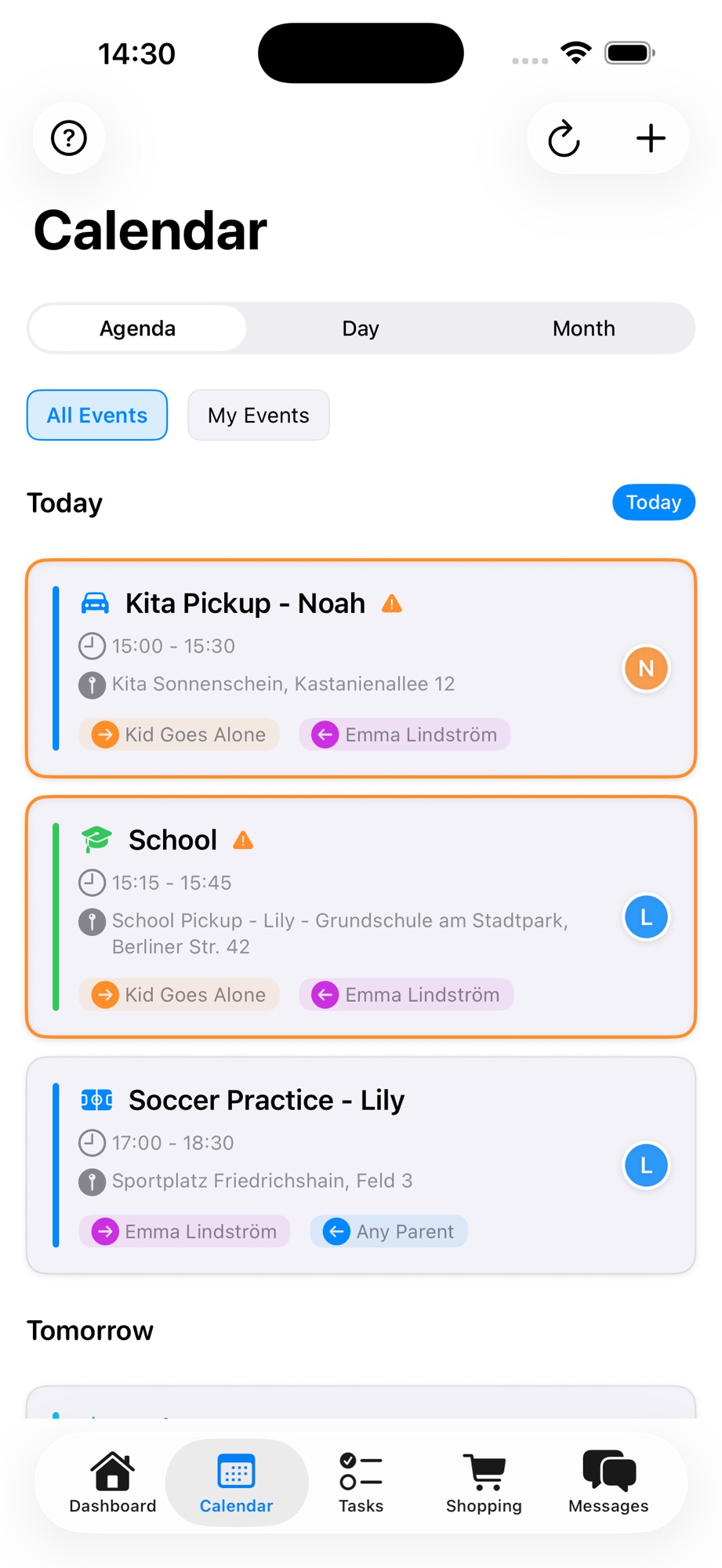
This is where having it all in one shared place pays off. Rather than a stack of printouts that gets lost by Friday, families increasingly keep emergency info, child profiles, and the weekly calendar in a single app like AuPairSync, so the au pair has everything in writing from the moment they walk in — and can check it themselves at 7am without waking anyone.
Save the Rules Conversation for Day Two or Three
The house-rules talk — hours, curfews, guests, car use, kitchen norms — is important, but it does not belong on arrival night. Have it once your au pair has slept and can actually engage as an adult in a two-way conversation. Our guide to house rules for au pairs gives you a ready-made structure so nothing gets missed and nothing feels like an ambush.
Handling Homesickness and Culture Shock From Hour One
Even a confident, well-traveled au pair can hit a wall in the first 48 hours. It usually isn't unhappiness — it's the sheer weight of everything being new at once. The way you respond early shapes how safe they feel asking for help all year.
What It Looks Like
- Quietness or withdrawal — often just exhaustion and overwhelm, not a bad fit
- Trouble sleeping or eating — jet lag scrambles both; a familiar snack from home helps more than you'd think
- Tears, sometimes out of nowhere — normal, and not a sign of regret
- Over-apologizing — anxiety about doing something wrong in a stranger's home
What Actually Helps
- Normalize it — "The first week feels strange for everyone. That's completely okay" removes the fear that something is wrong with them
- Protect their downtime — don't fill every evening with family activities; a person living with new people 24/7 needs moments alone
- Help them connect — WiFi to call home, and later, help finding the local au pair community
- Be patient with mistakes — most au pairs are 18 to 26 and may be living abroad for the first time. Patience now buys trust for the whole year
Once the dust settles, the first week's rhythm takes over — our first-week survival guide picks up exactly where arrival day ends, day by day through settling in.
The Complete Arrival Checklist
Everything above, in one scannable list you can work through:
The week before:
- Confirm flight number, terminal, and arrival time in writing
- Confirm who's doing the pickup, with a backup plan
- Agree on a physical meeting point at the airport
- Prep the landing kit (power bank, water, snack, SIM, address card)
- Ready the room (bedding, towel, toiletries, night light, water)
- Write down emergency info, child health profiles, and the draft schedule
Arrival day:
- Small welcoming party, correct name on the sign
- Lead with warmth, carry a bag, don't interview them in the car
- Home: bathroom, room, kitchen basics, WiFi — then let them sleep
- Make sure they can message home that they landed safely
- Schedule zero childcare
The first 48 hours:
- Day 2: real breakfast, unhurried house and neighborhood tour
- Day 3: introduce the children's routines, allergies, and daily rhythm; begin shadowing
- Have the house-rules conversation once they've slept, not before
- Watch for — and normalize — homesickness and culture shock
- Protect their alone time in the evenings
Arrival Day Is the First Chapter, Not a Test
It's easy to treat arrival day as a logistics problem to be solved — a flight to meet, a room to fill, a schedule to launch. But your au pair isn't arriving at a job. They're a young person who just left their entire life behind and flew across the world to live with people they've only met on a screen.
The families whose au pair year goes well almost all share one habit: they slow down at the very start. They meet the plane calmly, they let the first night be for sleeping, and they hold off on childcare until their au pair has actually arrived — not just physically, but emotionally. Everything measurable comes later. The first 48 hours are about one thing: showing this person that choosing your family was the right decision.
Get that right, and the schedule, the rules, and the routines all become easier — because they're built on a relationship that started with care instead of a checklist.

Getting ready for your au pair's arrival? Download AuPairSync and have emergency info, child profiles, and the weekly schedule ready to share from the moment they land.