
The Hendersons considered themselves "laid-back" host parents. When their first au pair, Julia from Brazil, arrived, they made a conscious decision not to overwhelm her with rules. "We want you to feel at home," they told her. "Just treat the house like it's yours."
Six weeks later, Tom Henderson was standing in his kitchen at midnight, staring at a pile of dishes from a dinner Julia had cooked for four friends — friends he'd never met, who had arrived unannounced while the kids were doing homework. His wife was upstairs, silently furious about the washing machine running at 11 PM. Julia, meanwhile, had no idea anything was wrong. She was treating the house like it was hers. Exactly as they'd asked.
The Hendersons didn't have a Julia problem. They had a house rules problem — specifically, the total absence of them.
This scenario repeats itself in host families around the world, and the root cause is always the same: well-meaning families confuse "welcoming" with "ruleless." They assume that setting boundaries will make their au pair feel like a servant rather than a family member. In reality, the opposite is true. Clear house rules are the foundation of a comfortable, respectful living arrangement. Without them, small irritations become silent resentments that poison the entire year.
Why House Rules Matter More Than You Think
Here's a truth that experienced host families learn the hard way: your au pair comes from a different culture, a different household, and often a different continent. What feels "obvious" to you — don't leave the front door unlocked, don't use the dryer for delicates, don't give the kids chocolate before dinner — is genuinely not obvious to someone who grew up with different norms.
In many Southern European and Latin American cultures, dinner at 10 PM is perfectly normal. In parts of Asia, removing shoes indoors is automatic but doing your own laundry as a house guest would be unusual. In Scandinavian countries, a sauna at midnight is Tuesday. Your au pair isn't being thoughtless when they do something that surprises you — they're operating from a different cultural playbook.
House rules bridge that gap. They're not about control. They're about clarity. And clarity, as any experienced host parent will tell you, is the single greatest predictor of a successful au pair year.
Research from the European Au Pair Association consistently shows that the most common reason for early terminations isn't personality clashes or homesickness — it's unmet expectations on both sides. House rules set those expectations before anyone has a chance to get disappointed.
When and How to Introduce Rules
Timing matters enormously. Dumping a ten-page document on your au pair the moment they walk through the door — jet-lagged, overwhelmed, and trying to remember your children's names — is counterproductive. They won't absorb any of it.
The better approach is a three-stage introduction:
Before arrival, send a brief overview of the most important rules — perhaps five or six essentials — along with your welcome information. This gives your au pair time to process and ask questions before they're standing in your kitchen feeling awkward. Frame it positively: "Here are some things about our household that will help you settle in quickly."
During the first three days, walk through the full house rules together. Do it room by room, conversationally, not as a lecture. "This is how the dishwasher works — we run it every evening after dinner. And this cabinet is yours for your own food, so you always have snacks you like." When they can see the actual spaces, the rules become concrete rather than abstract.
After the first two weeks, sit down for a casual weekly check-in. "How's everything going? Anything about the house rules that doesn't make sense, or anything you'd like to talk about?" This gives your au pair permission to raise things they've been silently confused about — and gives you a chance to address small issues before they calcify into problems.
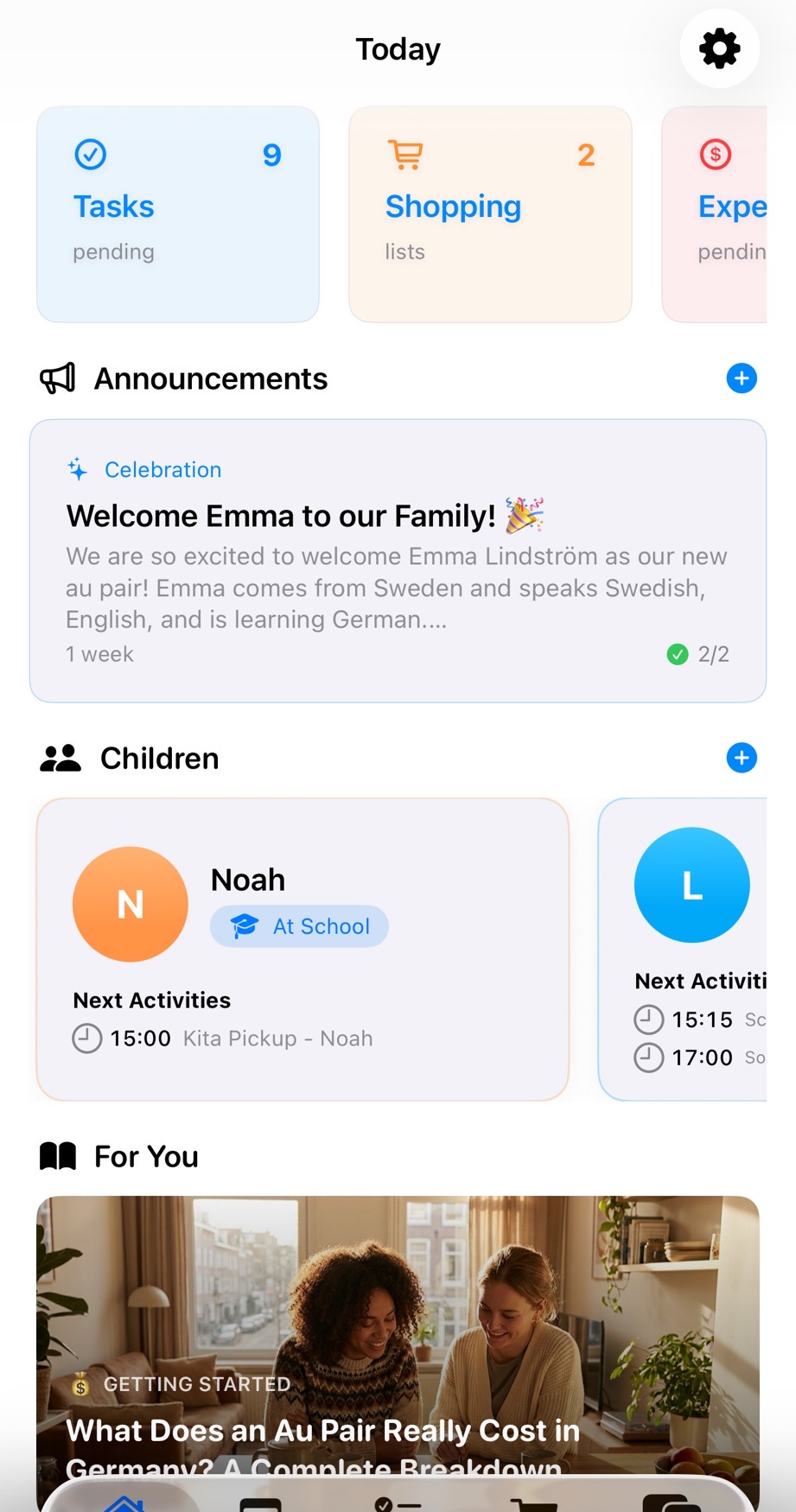
Write the rules down. Always. Memory is unreliable, especially across a language barrier. A shared document — in a tool like AuPairSync where both sides can reference it anytime — eliminates the "but I thought you said..." conversations that erode trust.
The Essential House Rules Every Family Needs
Not every household needs the same rules. A family in a city apartment has different concerns than one in a suburban house with a pool. But after talking to hundreds of host families, these categories cover the ground rules that matter most.
Kitchen and Food
The kitchen is the single biggest source of friction in au pair households. Not because au pairs are messy — but because kitchens are personal, and sharing one with a near-stranger requires explicit agreements.
Start with the basics. Does your au pair cook their own meals, or do they eat with the family? Most families offer a mix: shared dinners, independent breakfasts and lunches. Be specific about what food is shared and what's off-limits. "Help yourself to anything in the fridge" sounds generous until your au pair eats the organic salmon you'd been saving for date night.
A better approach: designate a shelf in the fridge and a cabinet for your au pair's personal food. Offer a monthly food budget — typically 50 to 80 euros — so they can buy ingredients they like without feeling dependent on your grocery choices. Make shared items clear: "Bread, milk, fruit, cereal, and anything in this drawer is always available to everyone."
Then tackle the kitchen rules that prevent midnight frustrations:
- Clean up after cooking — dishes washed or in the dishwasher, counters wiped, stove cleaned
- Don't leave the kitchen in a state that would surprise the next person using it
- If you finish something (milk, bread, coffee), add it to the shared shopping list
- The dishwasher runs every evening after dinner — here's how to load it properly
That last point sounds trivial, but dishwasher loading is a surprisingly common conflict. If you care about it (and many people do), show your au pair exactly how you prefer it done. Five minutes of demonstration prevents twelve months of quiet frustration.
Guests and Visitors
This is the rule category that families most often forget — and most often regret forgetting. Your au pair will make friends. Other au pairs, language classmates, maybe a romantic partner. At some point, they'll want to have people over.
Decide in advance what you're comfortable with, and communicate it clearly:
- Can the au pair have friends visit during the day? Most families say yes, as long as it's during off-duty hours and the au pair is responsible for their guests
- What about evenings? Many families are fine with friends visiting in common areas until a reasonable hour — say, 22:00 on weeknights
- Are overnight guests allowed? This varies widely. Some families allow occasional overnight guests with advance notice. Others have a strict no-overnight-guests policy. Neither is wrong, but the rule must be explicit
- Where can guests spend time? Living room, garden, au pair's room only?
- Are guests allowed when you're not home? When the children are present?
The guest question that causes the most damage when left unaddressed: romantic partners. It feels awkward to bring up, but silence creates far more awkwardness down the line. A simple "if you start dating someone, just let us know — we'd like to meet them before they visit regularly" is reasonable and respectful.
Curfew and Nighttime
Many host families set curfews, and there's nothing unreasonable about it. You have young children in the house, and knowing that the front door won't be opening and closing at 3 AM is a legitimate concern — for security, for noise, and for ensuring your au pair is rested enough to work the next morning.
Common approaches that work:
- Weeknight curfew: Home by 23:00 on Sunday through Thursday, especially when working the next morning
- Weekend curfew: More relaxed — midnight or 1:00 AM, or no fixed curfew with a "please be quiet coming in" agreement
- The text rule: Some families skip a hard curfew in favor of "just text us if you'll be later than midnight so we're not worried"
Whatever you choose, frame it as a shared household agreement rather than a parental restriction. "We all need to sleep, and the house isn't soundproofed — so let's agree on a time that works for everyone" lands better than "your curfew is 11 PM."
One practical tip: give your au pair their own key from day one, and show them exactly how to lock up. Nothing creates resentment faster than an au pair who feels they need to "ask permission" to come home.
Car Use
If your family owns a car and your au pair will be driving — whether for childcare duties or personal use — get the rules in writing. Car conflicts rank among the top five reasons au pair arrangements break down early.
Cover these specifics:
- Can the au pair use the car for personal errands? During which hours?
- Who pays for fuel? Most families cover fuel for childcare-related driving and ask the au pair to pay for personal trips
- What's the geographic limit? "Within the city" is different from "feel free to drive to the coast on weekends"
- What happens in case of a parking ticket, a fender bender, or a breakdown? Who pays the deductible?
- Are there vehicles the au pair should never drive?
If you're not comfortable with personal car use, say so upfront — and help your au pair understand public transport options instead. It's far better to set a clear boundary than to reluctantly agree and then silently resent every kilometer.
Household Chores and Tidiness
Au pairs are not housekeepers. This is worth repeating: au pairs are not housekeepers. Their primary role is childcare, and any household tasks should be directly related to the children — tidying the playroom, doing the kids' laundry, cleaning up after children's meals.
But "directly related to the children" can be interpreted broadly if you're not specific. Define exactly what's included and what's not:
Typically included: Children's laundry, tidying children's rooms and play areas, preparing children's meals and cleaning up afterward, loading the dishwasher after children's meals, keeping the au pair's own room tidy. For a deeper dive into structuring these responsibilities, see our task management guide
Typically not included: Parents' laundry, deep cleaning, vacuuming the whole house, gardening, ironing, cooking for the whole family, grocery shopping for the household
When in doubt, ask yourself: "Would I ask a babysitter to do this?" If the answer is no, it probably shouldn't be on your au pair's task list either.
Screen Time and Technology
This covers two separate areas: the children's screen time rules and the au pair's own device use during working hours.
For children's screen time, be explicit — and document it alongside other routines in your child profiles. "Limit screen time" means something different to every person on the planet. Say instead: "No screens before school. After school, 30 minutes of iPad is okay after homework is done. TV is fine during the last hour before bedtime — here are the approved shows."
For the au pair's phone use during working hours, most families take a common-sense approach: quick texts and calls are fine, but scrolling social media while supervising children is not. Frame it around child safety rather than distrust: "When you're with the kids, especially at the playground or near water, we need your full attention. Your phone should be in your pocket, not your hand."
Home Security
Don't assume any of this is obvious:
- Lock the front door whenever you leave, even for five minutes
- Set the alarm before bed — here's the code and how it works
- Never share the door code or house keys with anyone outside the family
- Close and lock all windows on the ground floor before leaving
- Here's where the spare key is kept (and who knows about it)
- In case of emergency, here are the numbers to call — and they're also in AuPairSync under emergency contacts
Quiet Hours and Shared Spaces
Living with someone new requires small courtesies that roommates learn to negotiate:
- Quiet hours after 22:00 — keep music, calls, and TV at low volume
- Shoes off inside (if that's your household norm)
- Shared bathroom schedule during morning rush — who showers when?
- How to handle the thermostat, air conditioning, and heating
- Smoking rules — most families require no smoking inside or near the house
The Golden Rule: Explain the "Why"
Rules without reasons feel like commands. Rules with reasons feel like common sense.
"Don't give the kids juice after 5 PM" sounds arbitrary. "Don't give the kids juice after 5 PM because the sugar makes bedtime a nightmare, and trust us, you'll be the one dealing with a wired three-year-old at 9 PM" makes perfect sense. Your au pair is far more likely to follow rules they understand.
This is especially important across cultural boundaries. In your au pair's home country, leaving the front door unlocked during the day might be perfectly normal. Explaining "we lock the door because there have been break-ins on this street" transforms the rule from a control mechanism into a shared safety practice.
Take the time to explain your reasoning — not for every tiny rule, but for the ones that matter. Your au pair is an adult living in your home, not a child following instructions. Treat them accordingly, and they'll respect both you and your rules.
What to Do When Rules Get Broken
They will. Not because your au pair is defiant, but because they're human, adjusting to a new environment, and learning as they go. How you handle the first few rule breaks sets the tone for the entire year.
Address it quickly. Don't let small things fester. "Hey, I noticed the kitchen wasn't cleaned up after last night — let's make sure we stay on top of that" is easy to say on day one. After three weeks of silently scrubbing someone else's dishes, it becomes an explosion.
Assume good intent. "I think there might have been a misunderstanding" is almost always true and always more productive than "you broke the rule about..."
Be specific about what needs to change. "Please be more careful" is vague. "Please make sure all dishes are in the dishwasher before you go to bed" is actionable.
Pick your battles. Not every rule is equally important. A forgotten kitchen cleanup deserves a gentle reminder. Leaving the front door unlocked overnight deserves a serious conversation. Calibrate your response to the actual impact.
Document patterns, not incidents. If the same rule keeps getting broken, it's time for a structured conversation — not a collection of grievances. "I've noticed the kitchen has been left messy three times this week" opens a discussion. "You never clean up after yourself" starts a fight.
Making It Feel Like Home, Not a Hotel
The secret to great house rules is that they shouldn't feel like rules at all. They should feel like "how we do things in this house" — the natural rhythms and courtesies that every household develops.
The families who get this right share a few habits:
They lead by example. If you expect your au pair to clean up after cooking, make sure they see you doing the same. Rules that only apply to the au pair feel punitive. Rules that everyone follows feel like family culture.
They give the au pair ownership over their space. Their room is their sanctuary. They can decorate it, rearrange the furniture, and close the door without explanation. The more personal space feels truly personal, the more comfortable the au pair feels respecting the shared spaces.
They update rules together. After the first month, after the first season change, and anytime something isn't working, sit down and adjust — ideally during a weekly check-in that gives both sides a regular space to raise things. Rules that evolve with the relationship feel collaborative. Rules carved in stone feel authoritarian.
And they celebrate what's working. "The morning routine has been running so smoothly — thank you for being so on top of it" costs nothing and means everything to someone 5,000 miles from home.
Your House Rules Checklist
Before your au pair arrives, have clear written agreements on:
- Kitchen use, food sharing, and cleanup expectations
- Guest and visitor policies (daytime, evening, overnight)
- Curfew or nighttime agreements
- Car use and fuel responsibilities
- Household chores scope (what's included and what's not)
- Children's screen time rules
- Au pair's phone use during working hours
- Home security procedures
- Quiet hours and shared space courtesies
- Smoking and alcohol policies
- What happens when rules are broken
Write them down. Share them in advance. Walk through them together. Store them somewhere accessible — like the documents feature in AuPairSync — and revisit them after two weeks, because the best house rules are living documents, not stone tablets.
Your au pair didn't move across the world to feel like a tenant with a rule book. They came for an experience — to be part of a family, learn a culture, and grow as a person. Good house rules don't diminish that experience. They protect it. Because when everyone knows where they stand, nobody wastes energy guessing — and everyone can focus on what actually matters: building a year that both your family and your au pair will remember for all the right reasons.