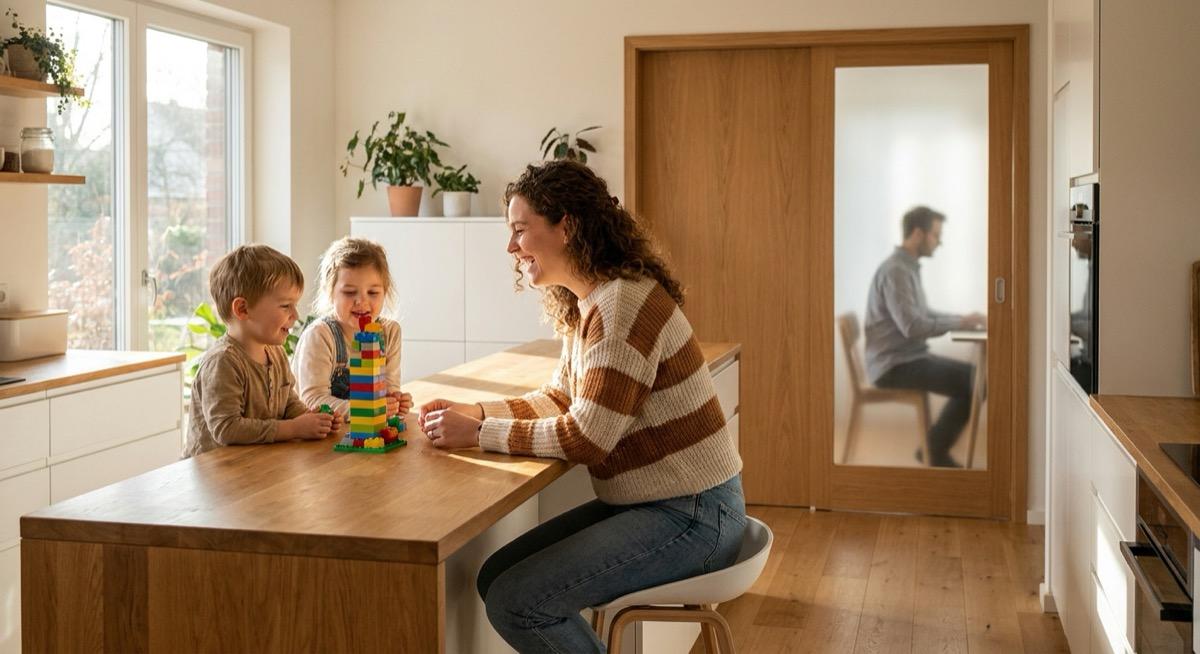
David thought he had thought of everything. When his company went hybrid and he started working three days a week from home, he and his wife Emma sat down with their au pair Sofia — six months into the year, doing brilliantly with the kids — and walked her through the new arrangement. He would be upstairs in the converted office, door closed during meetings. Sofia would handle the kids downstairs as usual. Same hours, same routine. Sorted.
By week six, David was eating lunch at his desk because every time he came downstairs he inherited a child for an hour. Sofia was losing her thread every twenty minutes when Lucas — four years old, magnetised to wherever Daddy was — wandered upstairs to interrupt. David's calendar quietly showed his deep-work hours had dropped 30%. Sofia had told a friend she was thinking about not extending.
The Garcia family did not have a Sofia problem. They had a working-from-home problem — specifically, the absence of any operational structure for what happens when both adults are in the same building, but only one of them is on duty.
This is the failure mode that hits most working-from-home host families in their first three months: not bad au pairs, not bad parents, just two adults sharing physical space without an explicit agreement about who covers what. Cultural Care will sell you on the convenience of having an au pair while you work remotely. AuPairMom forums are full of host parents quietly admitting their schedule unravelled the moment they started working from home. Nobody writes the actual operations guide.
Here it is.
Why Working From Home Breaks the Default Boundary
When an au pair started in pre-pandemic households, the boundaries were carved by geography. You left for the office at 8:00. You came home at 18:30. In between, the au pair ran the show. The handoffs were clean because they were physical: someone was either present or not.
Working from home dissolves all of that.
You are physically present, but operationally absent. Your au pair is operationally present, but no longer the only adult in the building. Your kids are physically with the au pair, but emotionally tracking where you are. None of these states are wrong on their own. The problem is that nobody has explicit rules for the in-between.
The three failure modes
Three patterns repeatedly break working-from-home arrangements. They almost never appear alone:
- Kid defaulting — children seek the parent, not the au pair, because parents are higher-status and more familiar. Even small interruptions ("Mommy, can I have juice?") cumulatively destroy the au pair's authority and your focus.
- Duty creep — parents take "quick" parenting moments during the workday (handing out snacks, refereeing a fight, fixing a tablet) without realising they are effectively shrinking their own work hours and blurring the line on the au pair's. Two adults end up doing parts of the same job.
- Surveillance fatigue — the au pair, doing exactly the same job they did before, suddenly feels watched. Every walk past the parent's office is a chance to be evaluated. Every minor parenting decision becomes a potential audit. Au pairs rarely say this out loud; they quietly disengage.
Key takeaway: Working from home with an au pair is not "the same arrangement, different geography." It is a structurally different setup that requires explicit rules about presence, handoffs, and who answers what. Without those rules, both you and your au pair end up doing worse versions of your jobs.
The Setup Conversation You Need Before You Start
If you are about to start working from home — or you have been doing it for months and it is not working — schedule a 60-minute conversation with your au pair. Not casual. Not "we should chat about this." A scheduled, sit-down session with the kids out of the house.
Cover these eight items, in this order:
- What "on duty" actually means — when you are upstairs in your office during work hours, your au pair is fully on duty. Not "kind of on duty if you need help." Fully.
- What an emergency looks like — define explicitly which situations actually warrant interrupting you (injury, illness escalating, locked-out delivery, fire). Everything else waits for lunch or the end of your work block.
- Your work hours, in writing — the same way the au pair's schedule is written down, yours should be too. "Roughly nine to six" is not a schedule.
- Where you will be physically — location matters. If you are on the kitchen table with a laptop, you will keep getting interrupted no matter what you say. Designate a closed-door space.
- How interruptions reach you — phone, message, knock? Pick one channel and stick to it.
- Your lunch break — this is where almost every WFH arrangement breaks. Decide whether your lunch is your own (eat alone, leave the house, read) or family time (eat with kids and au pair). Whichever you pick, name it explicitly.
- The handoff signal — the moment your work ends. A specific time, not "when I'm done."
- How the kids will be trained — your au pair cannot enforce "go to Sofia" if your kids have not been told. You and your partner have to do that part.
The output of this conversation should be a written agreement, visible to both of you. Verbal versions evaporate by week three.
Note: This conversation is the same kind of explicit boundary-setting you did when you set the original house rules — except this time the boundary is on you, not on your au pair. That asymmetry matters: your au pair cannot enforce a boundary you do not keep yourself.
The Physical Setup That Saves You
You can write the rules perfectly and they will still fail if your physical setup undermines them.
The closed door is non-negotiable
If you work from a kitchen island, a dining table, or a corner of the living room, no verbal agreement will protect your au pair's authority. Your kids will come to you because you are literally in their space. You are asking your au pair for the impossible: redirect a four-year-old away from the parent visible across the room.
A closed door — bedroom, study, basement, even a converted closet — does three things at once:
- Signals to your kids that you are not available
- Signals to your au pair that they are unambiguously in charge
- Removes you from peripheral vision so kid-defaulting reflexes do not fire
If you do not have a closed door available, this is the highest-ROI investment you can make in your au pair arrangement. A bookshelf with a curtain across a corner of the bedroom is enough — what matters is the visual barrier, not the architecture.
Status signals your kids can read
Once you have a closed door, your kids need a simpler rule than "knock when the door is closed." Most pre-school-age kids will knock anyway. Layer a visual signal on top:
- Door closed + light on / sign up: Daddy is in a meeting. Do not interrupt for any reason short of fire.
- Door closed, no light, no sign: Daddy is working. Sofia handles everything. Real emergencies only.
- Door open: Daddy is available. (Use sparingly — this is your "I'm coming up for air" state.)
Some families use a literal red/green sign. Some use a desk lamp visible through a glass panel. The format does not matter. The consistency does.
Where the au pair operates
The mirror question is where your au pair physically operates during your work hours. Two patterns work; one does not.
- Defined zone (living room + kitchen + outside): kids gravitate to where the au pair is, not where the parent is. Handoffs are clear.
- Run of the house, including near your office: kids treat the upstairs as fair game. Inevitable interruptions.
- Confined to one room with the kids while parent has the run of the house: builds resentment fast. Au pair feels demoted.
Pick zones. Document them. Do not let it drift.
Schedule Discipline When You Are Home
The hardest discipline of WFH host parenting is not your au pair's schedule. It is yours.
Defined start and end times — for you
Most au pair arrangements break because the parent's workday has no edges. You start at 9:00 (officially) but check email at 7:30. You "finish" at 18:00 but answer Slack until 19:30. Your au pair's contract says 14:00–18:00 afternoon coverage; in practice they cover until 19:45 because you are "almost done."
Working from home makes this asymmetry worse, because you are physically there to inherit the kids the moment your au pair signs off — even though, contractually, your au pair was off the clock thirty minutes ago.
Pick your work end time. Make it specific. Honour it the way you would honour leaving the office.
The lunch break trap
Lunch is where 80% of duty creep happens. Three common failure modes:
- You "eat with the kids" but actually take a meeting — you have effectively had the au pair work through your lunch (which is fine, but uncompensated and unacknowledged).
- You eat alone in the kitchen while the au pair eats with the kids — fine, except now the kids are reaching across to you for ketchup, paper towels, refereeing.
- You "give Sofia a break" by taking the kids during your own lunch — kind in spirit, chaotic in practice. You are not actually present for the kids; you are present-and-distracted, which is the worst of both worlds.
Pick one model and commit:
| Lunch model | Works when... | Watch out for... |
|---|---|---|
| Eat alone, leave the house | You can take 30 minutes outside | Don't skip — this is the only break in your day |
| Eat at desk, no contact | You need to hit a deadline | Don't pretend it's "lunch" — it's working through |
| Family lunch with explicit handoff | You genuinely want family time | Define a hard end (45 min) and return upstairs |
| Au pair takes a break, you cover | Your au pair's contract has a built-in break | This is your duty time, not a "favour" — log it |
Handoff rituals matter more than you think
The transition from "parent in office" to "parent off duty" needs a ritual, not just a clock. The most reliable: come downstairs, say hello to the kids and the au pair, ask one specific question about the day ("how was the park?"), then leave the kids with the au pair for the remaining handoff time before the au pair signs off.
This sounds trivial. It is not. Without an intentional handoff:
- Your au pair does not know when they are free
- Your kids do not know which adult to ask
- You end up "on duty" five minutes earlier than your contract says, every single day
A shared calendar is a good place to make these transitions visible to everyone. AuPairSync's published daily schedule shows your kids — and your au pair — exactly when each adult is on duty, which removes the "is Daddy still working?" question that interrupts both of you.
Helping the Kids Default to the Au Pair, Not You
Your au pair cannot compete with you for your kids' attention. You are the parent. The biological default beats anything else. The only solution is to actively redirect.
Train the kids during the first week
Spend the first week of any new WFH arrangement (or with any new au pair joining a WFH household) being extremely explicit:
- "When Daddy is upstairs, Sofia is in charge. If you have a question, ask Sofia."
- "Daddy can't help with snacks during the day. Sofia will help."
- "If Sofia says no, Daddy will say no too. We're a team."
Repeat this for at least a month. Children under six will need it daily. Older children will get it faster but will test it harder.
Don't undermine — even kindly
The single fastest way to destroy an au pair's authority is to overrule them on small things "to be nice."
- Sofia says no to a second cookie. Your kid finds you upstairs. You say "okay, just one more." Sofia just lost three weeks of work.
- Sofia is enforcing screen time limits. Your kid asks you. You say "five more minutes is fine." Now Sofia is the one who said no, and Daddy is the magic override.
The rule: if the au pair has made a call, you back the call. If you genuinely disagree, talk to the au pair privately, never in front of the kid. Adjust the policy together for next time.
The "go ask Sofia" reflex
Build the muscle, in yourself, of saying "go ask Sofia" — even when the answer is obvious to you. Especially when the answer is obvious. Every time you redirect, you reinforce the chain of authority. Every time you answer directly, you weaken it.
Key takeaway: Your au pair's authority over your kids during work hours is something you actively build, not something that exists by default. The parent who works from home and does not redirect kid-default reflexes will, within months, have an au pair the kids ignore.
Avoiding Surveillance Without Disengaging
The flip side of presence: when you are physically there all day, your au pair experiences a constant, low-grade audit.
You are not trying to surveil. You are just there. But every time you come down for water and witness a moment — a kid crying, a TV on at an unusual time, lunch happening at 13:15 instead of 13:00 — your au pair experiences it as evaluation. Many au pairs respond by stiffening, performing a more anxious version of their job, and quietly losing the relaxed competence that made you hire them.
What surveillance fatigue looks like
- Au pair becomes more formal in front of you, less themselves
- The kids' day becomes more visibly scheduled (because the au pair feels watched)
- Au pair stops making judgment calls and starts asking permission for everything
- Au pair retreats to their room during free time instead of staying in shared space
If you notice these shifts, do not address them by being warmer — that often reads as more performance pressure. Address them by being structurally less present.
Async check-ins beat hovering
You do not actually need real-time information about how the day is going. You need confidence at a few specific points: did the morning go well? Did pickup happen on time? Anything for me to know before I sign off?
Move these check-ins to async messages — a quick note in the morning ("kids fed, off to nursery") and an end-of-shift summary ("park, lunch, nap, art project — Lucas had a meltdown about shoes but recovered"). Two messages a day. No conversations through the office door.
This is one of the genuine wins from running a tool like AuPairSync's messaging for the WFH arrangement: the au pair logs the day's progress in a shared thread, and you read it on your terms. You stay informed without becoming the manager-walking-the-floor your au pair experiences when you keep popping down to "see how things are going."
The weekly check-in is mandatory
Working from home compresses small frictions into a daily reservoir. Without a structured weekly conversation, the small stuff piles up silently and explodes after about ten weeks. Your weekly 30-minute check-in — which you should be doing anyway — is the pressure release.
Use the weekly slot to surface specifically the WFH-related friction: were there interruptions you did not notice? Did handoffs feel clean? Was lunch awkward? You will not know unless you ask explicitly.
When You Genuinely Need to Step In
The boundary on the boundary: sometimes you do need to interrupt.
What actually counts as needing to step in
- Real emergencies: injury, illness escalating, locked out, a fire alarm. Always.
- Decisions only a parent can make: medication doses, accepting a new playdate invitation, signing off on something the au pair does not have authority for.
- Genuine logistical surprises: a package needs a signature, a workman arrives unannounced, school calls about an early pickup.
What does not count
- Your kid wants you specifically
- The au pair is doing something differently than you would
- You are feeling guilty for not being more present
- You finished a meeting early and want to "check in"
If you catch yourself stepping in for a non-emergency, name the urge, and don't. The discipline is in the boring middle: the moments where stepping in would feel kind but undermines the structure you have built.
How to step in without undermining
When you do need to interrupt, do it cleanly:
- Come down with a clear purpose, handle the thing, leave
- Do not take over the whole afternoon "while you're at it"
- Tell your au pair what you did and why ("I let Lucas have a popsicle because he banged his knee — wanted you to know in case he asks for another one")
- Return upstairs at a specific moment, not when "things feel calm"
A Day That Actually Works
Here is what a healthy WFH day looks like with a 30-hour-a-week au pair, two kids, and one parent working from home.
| Time | Parent | Au Pair | Kids |
|---|---|---|---|
| 7:30 | Coffee, breakfast with kids | Off duty | Breakfast |
| 8:30 | Door closes — work block 1 | On duty: nursery drop-off, park | At nursery |
| 12:30 | Quick lunch in office, no contact | Park to home, lunch with kids | Lunch with au pair |
| 13:30 | Work block 2 | Quiet time / nap watch | Nap or quiet play |
| 15:30 | Brief water break, two-sentence check-in | Snack, afternoon activity | Afternoon play |
| 17:00 | Wrap up, handoff ritual | Hands kids over, signs off at 17:30 | Family time begins |
| 17:30 | Family time | Off duty | Dinner with parents |
Three things make this work:
- Two clean blocks (morning and afternoon) with explicit door-closed signals
- One brief, structured check-in mid-afternoon — not three
- A handoff ritual at 17:00 that ends the au pair's coverage at the contracted time, not 17:45
Key takeaway: A good WFH day has two clean blocks of parent-unavailable, one clean handoff, and almost no real-time interaction during work hours. If your day has three or more parent-au-pair interactions before 17:00, something has drifted.
When the Setup Still Is Not Working
If you have done all of this and the arrangement still feels strained, look for one of these three root causes:
- Your kids have not been trained yet — give it more time and more repetition. Months, not weeks.
- Your physical setup is wrong — the door is not actually closing, or your au pair's zone overlaps too much with your work zone.
- The hours do not add up — your "30-hour week" is actually 38 hours of coverage, and your au pair is running on fumes. Audit honestly.
The same tools that help during a summer schedule transition help here: written agreements, visible schedules, explicit handoffs. Working from home is not a different category of problem; it is the same coordination problem made harder by physical proximity.
The Bigger Picture
Working from home with an au pair is not a hack to get more parent-time during the workday. It is not a way to "have it all" by being present without being present. It is a specific, demanding operational arrangement that needs the same explicit structure as any other complex household coordination.
The families that make it work share one thing: they have stopped trying to be both parent and manager during work hours. They have decided that during work hours, the au pair is the parent on duty — and they back that role with their physical setup, their language, their schedule discipline, and their willingness to redirect their own kids. The au pair, in turn, has the authority to actually do the job they were hired for.
The reward is real. Your au pair gets a sustainable arrangement and the dignity of doing meaningful work. Your kids get an attentive caregiver, not a confused multi-adult environment. You get the deep work hours you went home for in the first place. None of these are guaranteed by the geography of working from home. They are built, deliberately, by every decision you make about how to share the same building.
Working from home with an au pair? Download AuPairSync to keep schedules, handoffs, and async check-ins clear from day one.