
Claire had done everything right — or so she thought. She'd spent the first evening walking her new au pair, Lucia from Spain, through the entire daily routine. Breakfast at seven, school drop-off at eight, laundry in the morning, pick-up at three, snack, homework, dinner prep starts at five. Lucia had nodded along, taken notes on her phone, and seemed completely on top of it.
By the second week, things were slipping. The laundry was done but never folded. The kids' lunchboxes came back with the same uneaten sandwiches because Lucia didn't know about Max's new aversion to cheese. The dishwasher was loaded but never started. When Claire mentioned the dinner prep, Lucia looked confused — she'd understood that as an optional task, not a daily expectation.
Claire wasn't dealing with a careless au pair. She was dealing with the oldest problem in household management: verbal instructions vanish the moment they leave your mouth. And when you layer in a language barrier, jet lag, a new country, and the sheer volume of information a new au pair absorbs in week one, it's remarkable that anything sticks at all.
The solution isn't to repeat yourself louder or more often. It's to build a task system — a clear, written, visual structure that tells your au pair exactly what needs doing, when, and how. Written down once, a task no longer has to be explained again every morning — which leaves fewer gaps for misunderstandings and less time spent managing your au pair, not more.

Schedules, tasks and costs with your au pair, in one app.

Why Verbal Instructions Always Fail
It feels natural to explain things as they come up. "Oh, and on Tuesdays you'll need to take Emma to ballet at four." "The recycling goes out on Thursday mornings." "If the kids haven't finished homework by five, let me know." These instructions make perfect sense to you — you've been running this household for years. But for your au pair, each one is a single data point in an avalanche of new information.
The information overload problem
Research on cognitive load shows that people can hold roughly four to seven new items in working memory at a time. Your au pair, during their first week, is absorbing hundreds: names, addresses, school gates, alarm codes, food preferences, bedtime routines, neighbourhood shortcuts, bus routes, cultural norms they've never encountered. Verbal task instructions compete with all of this — and they lose.
The result is predictable. Your au pair remembers the big things (school drop-off, meal times) but forgets the small ones (starting the dishwasher, watering the plants, putting the bins out). You interpret this as carelessness. They experience it as impossible expectations delivered without a reference point. Both of you grow frustrated, and neither of you is wrong.
Key takeaway: Your au pair isn't forgetful — they're overwhelmed. Written task lists aren't a sign of distrust. They're a sign of good management.
The "I thought you meant..." trap
Verbal instructions are ambiguous in ways you don't notice until something goes wrong. "Clean up after lunch" means one thing to you (wipe the table, load the dishwasher, sweep the floor, put food away) and something completely different to a 20-year-old from a culture where "cleaning up" means stacking plates by the sink. Neither interpretation is wrong — but only one of them is what you actually wanted.
Written tasks eliminate this ambiguity. When "clean up after lunch" becomes a checklist — wipe table, load dishwasher, sweep floor, put leftovers in fridge — there's no room for interpretation. Your au pair knows exactly what "done" looks like, and you don't have to explain it again.
What Makes a Good Task Assignment
Not all task descriptions are created equal. A vague task creates confusion. An overly detailed task feels condescending. The sweet spot is a task that answers four questions.
The four-question test
Every task you assign should answer:
- What needs to be done — the specific action, not a category
- When it needs to happen — a time, a trigger, or a deadline
- How it should be done — only if the method matters or isn't obvious
- What "done" looks like — so your au pair can self-check
Here's the difference in practice:
| Vague task | Clear task |
|---|---|
| "Do the laundry" | "Put a load of whites in the washing machine by 9:00. Hang to dry on the rack in the utility room." |
| "Get the kids ready" | "Wake Max and Lena at 7:00. Breakfast options are on the counter. Both need to be dressed with bags packed by 7:45." |
| "Tidy the playroom" | "Before dinner, put toys in the labelled bins. Books go on the shelf. Check the floor for small pieces — Lena puts everything in her mouth." |
| "Handle dinner" | "Start heating the pasta sauce at 17:15. Boil water for spaghetti at 17:30. Serve at 18:00. Portions for the kids are smaller — one ladle of sauce each." |
Notice that the clear versions aren't controlling — they're specific. They respect your au pair's time by not making them guess, and they respect your standards by making expectations visible.
Key takeaway: A good task tells your au pair what to do, when to do it, how (if it matters), and what "done" looks like. If you can answer those four questions, you have a clear assignment.
When to include "how" and when to skip it
Not every task needs step-by-step instructions. Your au pair is an adult, and treating every task like an IKEA manual will feel patronising. The rule of thumb:
- Include "how" when the method genuinely matters (loading the dishwasher a specific way, applying sunscreen before the park, using a particular car seat setup)
- Skip "how" when the outcome is what matters and there are multiple acceptable paths (tidying a room, preparing a simple snack, sorting recycling)
If you're unsure, ask yourself: "If my au pair does this differently than I would, does it matter?" If the answer is no, describe the outcome and let them figure out the method.
The Three Types of Au Pair Tasks
Not all tasks work the same way. Understanding the difference helps you communicate them more effectively — and helps your au pair prioritise when things get hectic.
Daily routines
These are tasks that happen every single day, at roughly the same time, in roughly the same way. Morning routine, school drop-off, afternoon pick-up, bedtime routine. They're the backbone of your au pair's schedule.
Daily routines should be written down once and referenced constantly. A printed weekly schedule template on the fridge, a shared digital list, a note in your family dashboard — whatever format works, as long as it's always accessible. Don't rely on your au pair memorising the routine after being told once. Even after three months, having a reference point prevents the slow drift where small steps get dropped.
- Morning routine (7:00–8:15): Wake kids, supervise breakfast, check bags are packed, school drop-off by 8:15
- Afternoon routine (15:00–17:30): School pick-up at 15:00, snack, homework supervision, free play or activity
- Evening routine (17:30–19:00): Dinner prep, dinner, kitchen cleanup, start bedtime routine at 18:45
Recurring tasks
These happen regularly but not daily — weekly laundry, Thursday grocery shopping, Monday ballet class, bi-weekly room tidying. The danger with recurring tasks is that they're easy to forget because they don't happen often enough to become automatic.
A simple weekly overview works well:
| Day | Recurring task | Time |
|---|---|---|
| Monday | Ballet drop-off (Emma) | 16:00 |
| Tuesday | Grocery shopping (list on fridge) | 10:00 |
| Wednesday | Playdate at the park with Sophie's au pair | 15:30 |
| Thursday | Bins out (recycling + general waste) | Before 8:00 |
| Friday | Tidy playroom thoroughly, vacuum kids' rooms | 10:00 |
Post this somewhere visible. Update it when things change — and tell your au pair when you update it, don't just silently edit the document.
One-off tasks
These are tasks that come up irregularly: pick up a prescription, take the car for an MOT, buy a birthday present for Saturday's party, meet the plumber between 10 and 12. One-off tasks are where communication breaks down most often because there's no routine to fall back on.
For one-off tasks, the key is lead time and detail. Don't mention a task at breakfast and expect it done by lunch unless it's truly simple. Give your au pair at least 24 hours' notice for anything that requires planning — and write it down, even if it feels like overkill. A quick message saying "Tomorrow (Thursday): plumber coming between 10–12, please be home to let them in, they'll need access to the bathroom under the stairs" takes thirty seconds to write and prevents a missed appointment.
Key takeaway: Daily routines need a permanent reference. Recurring tasks need a weekly overview. One-off tasks need written notice with enough lead time.
How to Introduce Tasks Without Micromanaging
There's a fine line between clarity and control. Cross it, and your au pair feels like they're being watched rather than supported. The goal is to give them enough structure to succeed independently — then step back.
Start structured, then loosen
During the first week, more structure is better. Walk through the daily routine together. Do tasks side by side for the first few days — not because you don't trust your au pair, but because showing is faster and clearer than telling. "Let me show you how we do the school run" is collaborative. "Make sure you do the school run exactly like this" is controlling. Same information, different framing.
After the first two weeks, start stepping back. Instead of checking every task, check outcomes. Are the kids fed and happy? Is the kitchen clean after meals? Is the laundry getting done? If the answers are yes, resist the urge to optimise how your au pair gets there.
The 80/20 rule of household tasks
Here's a truth that saves host families enormous amounts of stress: your au pair will do about 80% of tasks exactly the way you want, and 20% differently. The question is whether that 20% actually matters.
The dishwasher loaded slightly differently than you prefer? Doesn't matter — the dishes are clean. The kids' hair parted on the wrong side? Doesn't matter — they're groomed and at school on time. The playroom tidied with stuffed animals in the wrong bin? Doesn't matter — the room is tidy.
Save your corrections for things that genuinely affect safety, child wellbeing, or household function. Everything else, let go. Your au pair is not a clone of you, and trying to make them one will exhaust you both.
- Worth correcting: Car seat installed incorrectly, allergenic food given to a child, medication timing wrong, front door left unlocked
- Not worth correcting: Different folding technique for towels, slightly different lunch presentation, toys sorted into bins differently than you'd choose
Use tools, not surveillance
The best task management systems give your au pair autonomy while keeping you informed. A shared task list where your au pair can check off completed items gives you visibility without requiring you to ask "did you do X?" five times a day.
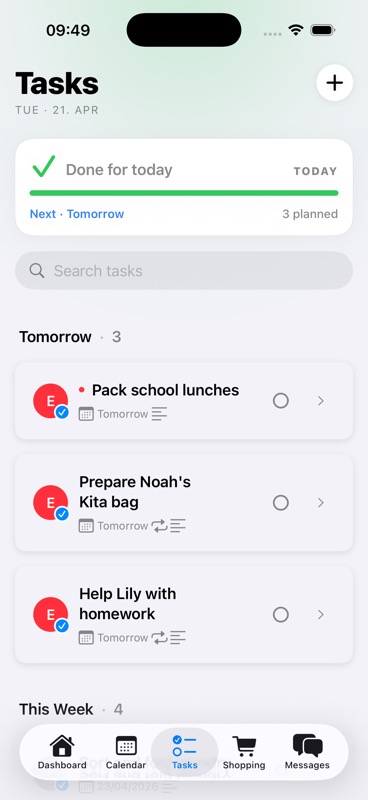
Tools like AuPairSync's visual task management let you create tasks with photos and instructions, so your au pair always has a reference — and you can see at a glance what's been completed without hovering. It replaces the daily debrief with a system that runs quietly in the background.
When Tasks Go Wrong: Feedback That Actually Works
Even with the best system, things will go wrong. Tasks will be forgotten, done incorrectly, or done halfway. How you handle these moments determines whether your au pair improves or shuts down.
Address it early, address it calmly
The worst thing you can do is let small issues accumulate until you explode over something trivial. If the kitchen isn't being cleaned properly after lunch, mention it the first time — not the fifteenth. The longer you wait, the more your frustration builds, and the more blindsided your au pair feels when you finally say something.
Frame feedback around the task, not the person:
- Task-focused: "The kitchen counter still had crumbs after lunch today — could you make sure to wipe it down as the last step?"
- Person-focused: "You're not cleaning the kitchen properly."
The first version tells your au pair exactly what to fix. The second tells them they're failing. One leads to improvement; the other leads to defensiveness.
The feedback sandwich is dead — try this instead
Forget the old "compliment, criticism, compliment" pattern. It's transparent, and most people learn to ignore the compliments and brace for the middle. Instead, try direct-but-kind:
- State the issue — factually, without emotion: "I noticed the kids' lunchboxes came back untouched on Monday and Wednesday."
- Ask, don't assume — there might be context you're missing: "Is there something going on with the lunches? Are the kids saying they don't like something?"
- Agree on a fix together — give your au pair agency in the solution: "Would it help if we made a list of what each kid actually eats? We could update it together."
This approach treats your au pair as a partner in problem-solving rather than a subordinate receiving a reprimand. It also surfaces information you might not have — maybe Max told Lucia he's "not allowed" to eat the cheese sandwiches, and she believed him.
Key takeaway: Address task issues early and frame feedback around the task, not the person. Ask before you assume — your au pair may have context you don't.
Weekly check-ins prevent most problems
The single most effective tool for ongoing task management is a brief weekly conversation. Not a performance review — a check-in. Fifteen to thirty minutes where you review what's working, what's not, and what's changing next week.
This is where you adjust the task list based on real experience. Maybe the Thursday grocery run doesn't work because the market is too crowded. Maybe the bedtime routine needs an extra fifteen minutes since the kids moved to a later bath time. These adjustments happen naturally in a weekly check-in and prevent small mismatches from becoming entrenched problems. For a detailed guide on running these meetings, see our weekly check-in guide.
Building a Task System That Runs Itself
The goal of task management isn't to manage tasks forever — it's to build a system that your au pair can run independently. Here's what that system looks like when it's working well.
The three-document system
Most successful host families keep three reference documents:
- Daily routine — the backbone schedule that covers every working day, posted somewhere visible and always accessible
- Weekly overview — recurring tasks mapped to days of the week, updated when things change
- House manual — the "how to" reference for anything that isn't obvious: how the washing machine works, where the first aid kit is, what the school's phone number is, which neighbours have spare keys
The daily routine and weekly overview are active documents — your au pair references them constantly. The house manual is a reference document — consulted when something unusual comes up. Together, they answer 90% of your au pair's questions without requiring a phone call or text.
You set house rules to define boundaries. You use a task system to define responsibilities. They complement each other — rules say what's expected of everyone in the household; tasks say what's expected during working hours.
Make updates visible
Task systems fail when they become static. Your household changes — school schedules shift, kids develop new interests, seasonal activities start and stop. When the task list doesn't reflect reality, your au pair either ignores it (because it's outdated) or follows it (and does the wrong thing).
When you change a task or add a new one:
- Tell your au pair directly — don't just edit a document silently
- Explain why — "Emma's swimming moved to Wednesdays because the Tuesday slot was full" gives context that helps your au pair remember
- Remove obsolete tasks — a cluttered list with crossed-out items and outdated entries is harder to scan than a clean, current one
Trust builds over time
In the first month, you'll check tasks more often. That's normal and expected. By month three, if your system is working, you'll barely think about it. Your au pair will know the routine, handle recurring tasks without reminders, and come to you proactively when one-off tasks need clarification.
This is the real payoff of a good task system: it doesn't just organise chores. It builds mutual trust. Your au pair feels competent because they know exactly what's expected. You feel confident because you can see what's getting done. And your daily schedule runs smoothly without constant negotiation.
Key takeaway: A good task system isn't about control — it's about building a structure that lets your au pair work independently and confidently.
The Bigger Picture
Task management sounds mundane. Nobody dreams about optimising their au pair's weekly chore list. But the families who get this right — who take the time to write things down, communicate clearly, and build a system instead of relying on verbal instructions and goodwill — are overwhelmingly the families who describe their au pair year as "the best decision we ever made."
The tasks themselves don't change. Someone still needs to do the school run, fold the laundry, and start dinner at five. What changes is the friction around those tasks. When expectations are clear, mistakes are addressed kindly, and your au pair has the autonomy to manage their own responsibilities, the household stops feeling like a series of small negotiations and starts feeling like a team.
That's what task management really is. Not a checklist. A relationship tool.
Ready to simplify task management with your au pair? Download AuPairSync to create visual task lists with photos, track daily responsibilities, and keep everyone on the same page — from day one.